Wärtsilä: All-Time High Operating Result And Cash ...
2 months ago

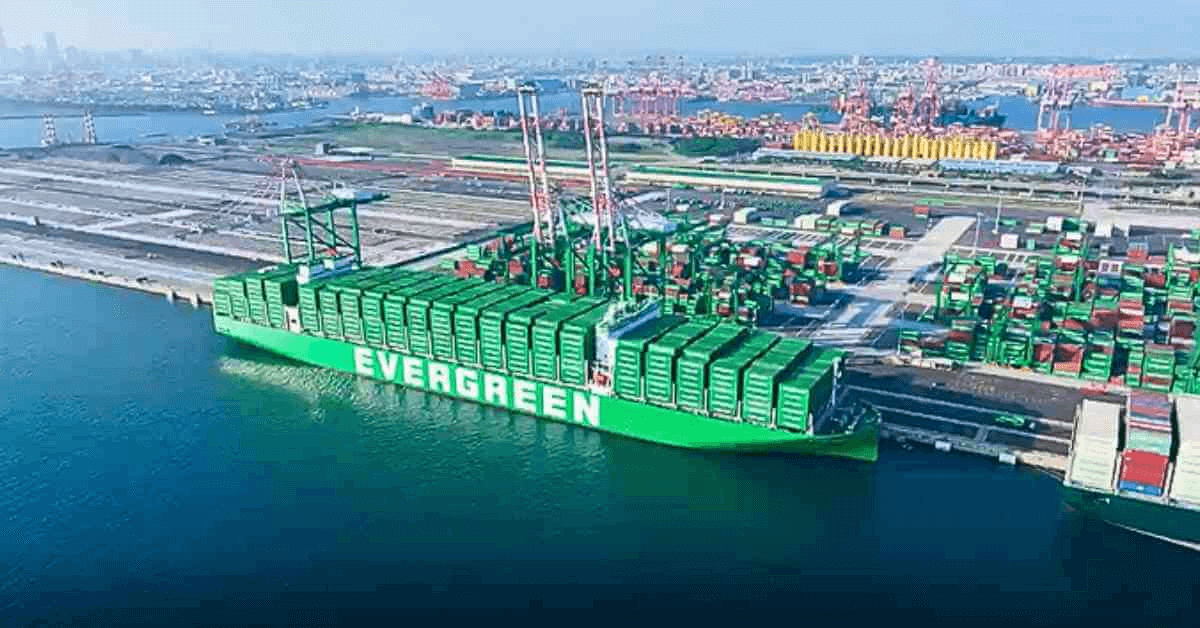

Shanghai has completed the world’s first ship-to-ship transfer of liquid carbon dioxide (LCO₂) captured from a ship’s emissions.
The operation took place on June 19 at the Shengdong Terminal of Yangshan Deepwater Port, where the barge “Dejin” docked alongside the Panamanian-flagged container ship “EVER TOP.”
The EVER TOP, the world’s first container ship fitted with an onboard carbon capture system, successfully offloaded the captured CO₂ directly to another vessel. This follows its earlier milestone in 2023, when it completed the first-ever ship-to-shore transfer of captured CO₂ at the same port.
The system, known as the Onboard Carbon Capture and Storage (OCCS) system, enables vessels to trap and store CO₂ from their own exhaust gases during voyages.
Su Yi, general manager of the institute’s Environmental Equipment Division, stated that the system is capable of capturing over 80% of carbon dioxide emissions with a purity of 99.9%. He explained that retrofitting a large container ship like the 14,000-TEU EVER TOP with this system costs around $10 million, less than half the price of converting the ship to run on methanol or ammonia, which are the current alternatives for reducing emissions.
The captured carbon dioxide is not wasted. It can be sold for use in industrial applications, with the potential to generate up to $8 million per year in revenue per ship. This turns emissions, once considered waste, into a commercial asset.
A key challenge with carbon capture on ships has been the difficulty of unloading the captured CO₂. Many industrial buyers are located near smaller ports that are not equipped to receive large vessels. This has made offloading costly and logistically complex.
Video Credits: ShanghaiEye/YouTube
The newly demonstrated ship-to-ship transfer method solves this problem. Instead of requiring specialised port infrastructure, the CO₂ can now be transferred directly from one ship to another while at sea or anchored offshore. This adds flexibility to the process and significantly reduces transportation costs.
Du Mingsai, who managed the transfer operation, said that ship-to-ship transfer is far more efficient than traditional methods. One CO₂ carrier can transport dozens or even hundreds of times more gas than a standard tanker truck. This makes it easier to scale up operations and meet the needs of industrial users in different regions.
This innovation completes a full “closed-loop” cycle, starting from carbon capture onboard, followed by liquefaction and storage, and ending with ship-to-ship transfer for delivery to end users. The entire process is now integrated at sea without relying on heavy port infrastructure.
Shanghai’s successful demonstration provides what officials are calling a replicable “Shanghai Solution” for reducing carbon emissions from ships globally.
According to data from the International Maritime Organization (IMO), the global shipping sector emits roughly 1 billion tons of CO₂ each year, accounting for nearly 3% of worldwide emissions.
Experts from the Shanghai institute are now contributing to the IMO’s newly formed working group on OCCS systems. Their experience is expected to help shape global standards and regulations for onboard carbon capture and its safe and efficient transfer between vessels.
Reference: shanghai
Disclaimer :
The information contained in this website is for general information purposes only. While we endeavour to keep the information up to date and correct, we make no representations or warranties of any kind, express or implied, about the completeness, accuracy, reliability, suitability or availability with respect to the website or the information, products, services, or related graphics contained on the website for any purpose. Any reliance you place on such information is therefore strictly at your own risk.
In no event will we be liable for any loss or damage including without limitation, indirect or consequential loss or damage, or any loss or damage whatsoever arising from loss of data or profits arising out of, or in connection with, the use of this website.
Disclaimer :
The information contained in this website is for general information purposes only. While we endeavour to keep the information up to date and correct, we make no representations or warranties of any kind, express or implied, about the completeness, accuracy, reliability, suitability or availability with respect to the website or the information, products, services, or related graphics contained on the website for any purpose. Any reliance you place on such information is therefore strictly at your own risk.
Do you have info to share with us ? Suggest a correction