Damen delivers CSOV 9020 TSS Cruiser to Ta San Sha...
5 hours ago

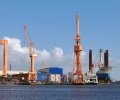

South Korea’s three major shipbuilders—HD Hyundai Heavy Industries, Hanwha Ocean, and Samsung Heavy Industries—have seen their order intake for this year reach only 50–70% of their annual targets as of the end of the third quarter (July–September). While reduced global ship orders compared to last year have played a role, the sharp cooling of the liquefied natural gas (LNG) carrier market, a key revenue driver for the Korean shipbuilding industry, is identified as the primary cause.
Global LNG carrier orders plummeted by 82.9% in the first half compared to the same period last year. Korean shipyards, which secured 68 LNG carriers annually last year, have only managed to secure 18 vessels as of the third quarter this year. With the high-margin LNG carrier market slowing, industry insiders are debating whether this is a “breather” or the start of a structural slowdown. Short-term concerns about oversupply have also emerged, while long-term expectations for a new boom driven by large-scale LNG projects, such as the Alaska Project, are growing.
Sharp Decline in LNG Carrier Orders in First Half… Immediate Work Remains
According to industry sources, HD Korea Shipbuilding & Offshore Engineering, the intermediate holding company of HD Hyundai’s shipbuilding division, secured 93 vessels worth $12.37 billion (approximately 17.55 trillion Korean won) this year, achieving 68.5% of its annual target of $18.05 billion. Samsung Heavy Industries, which secured 27 vessels, achieved 51% of its annual target of $9.8 billion (approximately 13.9 trillion Korean won) with $5 billion. Hanwha Ocean, which did not set a target, secured 32 vessels worth $6.32 billion (approximately 8.97 trillion Korean won), 71.3% of last year’s figure. The shipbuilding industry, which typically achieves annual targets early by the third quarter, underperformed due to the rapid contraction of the LNG carrier market.
However, there is no immediate concern about production gaps, as shipyards still have enough work for about three years. According to the Export-Import Bank of Korea, as of early July, the order backlog of Korean shipbuilders stood at 35.58 million CGT (compensated gross tonnage). Still, securing future orders is critical to prevent a “cliff-like drop” in orders.
◇ Hopes for a Fourth-Quarter Rebound… North America-Driven LNG Projects
The industry expects a turnaround in the fourth quarter, as large-scale overseas LNG projects are set to drive new orders. Australia’s largest energy company, Woodside Energy, is considering ordering 16–20 LNG carriers. U.S. energy company Sempra Energy, which is expanding its business to supply North American LNG to Asia and Europe, has made a final investment decision on a $14 billion LNG project. In particular, as the Trump administration tightens regulations on Chinese shipbuilding and shipping, Korean shipbuilders are expected to benefit from the expansion of North American LNG exports.
The long-term supply-demand outlook for LNG carriers is also positive. British maritime analysis firm Drewry forecasts that the global LNG carrier fleet will need 150–250 more vessels by 2030. The analysis highlights that demand for replacing aging ships will surge after 2027 due to new liquefaction facilities and stricter environmental regulations from the International Maritime Organization (IMO). However, warnings are emerging that Korea’s focus on LNG carrier orders could pose risks. The UCL Energy Institute at the University of London cautioned, “The LNG carrier market is a cyclical industry that has repeatedly experienced oversupply and downturns after rapid demand growth. There is a high risk of oversupply recurring within the next decade.”
Experts emphasize, “While LNG carriers are a ship type where Korea maintains a technological gap over China, a strategy to diversify portfolios into container ships, bulk carriers, and offshore plants should be pursued in the medium to long term.” Yang Jong-seo, a senior researcher at the Export-Import Bank of Korea, said, “While maintaining a monopoly in the LNG carrier market, it is also necessary to increase market share by adding high value to larger bulk carriers, tankers, and container ships.”
Source: The Chosun Daily