ZPMC Showcases Port Equipment Models at Chinese Co...
7 hours ago

During a festive gathering on the Maasvlakte, Port of Rotterdam Authority, ProRail, and Swietelsky Rail Benelux gave the go-ahead for construction of the Maasvlakte Zuid (EMZ) Railway Yard.
This was done in the presence of representatives from the Municipality of Rotterdam, the Ministry of Infrastructure & Water Management, and the European Parliament. The first phase of the project involves construction of the initial bundle of six sidings suitable for 740-meter trains and various connections to existing rail infrastructure. This bundle will be commissioned in mid-2027. The remaining three bundles will be implemented in phases depending on rail freight transport forecasts in the period after 2027.
Startein bouw Emplacement Maasvlakte Zuid
Following preparatory work by Swietelsky, construction has now officially begun on the first bundle and the various connections as part of the new Maasvlakte Zuid Railway Yard (EMZ). The construction of the EMZ is necessary to facilitate the growth of rail freight transport from the Maasvlakte to the European hinterland. Container throughput in the port of Rotterdam is expected to continue increasing in the coming years. The import and export of containers is crucial for companies and consumers in both the Netherlands and Europe and is thus essential to European prosperity. To continue transporting the ever-increasing flow of containers to and from the hinterland efficiently, Port of Rotterdam Authority, ProRail, and the Ministry of Infrastructure & Water Management are investing in sustainable and efficient rail infrastructure.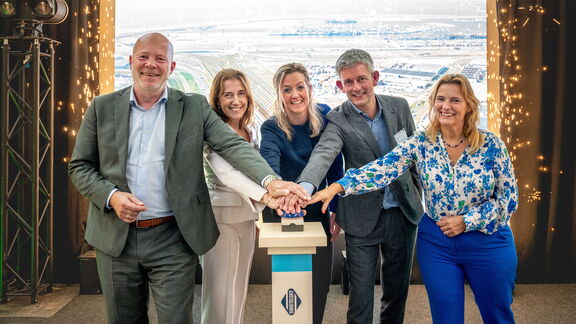
Economic and social prerequisites
Efficient and accessible international rail connections with short transit times from ports and industrial clusters are crucial for the economy and society and provide a competitive advantage for the Netherlands. These are key prerequisites for our seaports, and thus for the Dutch economy. The Trans-European Transport Network (TEN-T), and specifically the Rail Freight Corridors, enable greater volumes of cargo to be transported by rail more quickly and with minimal delays: safely, reliably, and sustainably.
Railway yard suitable for 740-meter trains
The Maasvlakte Zuid railway yard is suitable for freight trains with a length of 740 metres. That is considerably longer than the current standard length of approximately 600 meters. The longer trains offer a number of advantages. The longer trains allow more containers to be transported in a single trip. This means fewer train movements, lower emissions, and reduced costs per tonne of freight.
Resolving capacity bottlenecks on the Port Railway Line
Various infrastructure projects are planned until 2040 to improve rail accessibility to the Maasvlakte. The Port Authority is implementing these projects in phases in collaboration with ProRail and the Ministry of Infrastructure & Water Management. In addition to the construction of the new railway yard with a maximum of four bundles of six tracks each, the total development also includes the electrification of the distribution triangle and the outer contour, the modification of the C2 curve, and the construction of two through tracks.
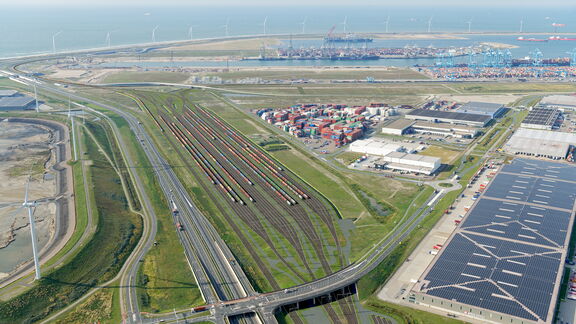
Emplacement Maasvlakte Zuid
Future-proof port
The construction of the EMZ is part of the Port Authority’s efforts to encourage rail freight transport. In addition to rail freight transport having lower emissions of CO₂, NOₓ, and particulate matter than road transport, it is crucial to make optimal use of all available modes of transport in order to keep the port accessible. Not only by investing in new infrastructure, but also by using existing capacity in a smarter and more efficient way. This requires a joint approach in which market parties and public organizations continuously work together on improvement. Digital solutions play a key role in this. Additional measures to relieve congestion on the road network and encourage the transport of containers by inland waterway are also important in this regard. ProRail and the Port of Rotterdam Authority are fully committed to a robust hinterland rail connection. This allows more containers to be transported by rail rather than road, thereby reducing road congestion and providing a reliable alternative to inland waterway transport during periods of low water levels.
Source: Port of Rotterdam