RIFT chooses port of Rotterdam for the development...
6 hours ago

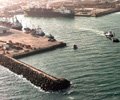
WESTPORTS Holdings Bhd (KL:WRPTS) plans to use part of the proceeds raised through its dividend reinvestment programme (DRP) to invest in other ports or businesses “if a good one comes along”, says executive chairman Datuk Ruben Emir Gnanalingam.
After having dedicated the past seven years to securing approval for its next expansion phase, dubbed Westports 2, the country’s largest gateway port operator is now exploring growth opportunities beyond its new terminals.
“With Westports 2 underway, we are now exploring opportunities to expand elsewhere, but only if a good opportunity presents itself,” Ruben tells The Edge in an exclusive interview.
Westports has launched a DRP to raise up to RM600 million over five years to support working capital, capital expenditure (capex), long-term growth initiatives and other potential needs to be identified at the point when such funds are retained. About RM400 million of the proceeds will fund the equity portion of Westports 2, leaving about RM200 million available for other expansion opportunities, says Ruben.
Asked what types of ports Westports was targeting, Ruben candidly says: “Ports that make money”, indicating a preference for brownfield investments over greenfield projects.
“We’re interested in any port that generates profits, ideally container ports. If the right opportunity arises, we may allocate some [of the DRP proceeds] for that, if there’s any excess.”
MMC Ports Holdings Sdn Bhd is in the process of listing on Bursa Malaysia through an initial public offering (IPO), which would make it the third listed pure port operator alongside Westports and Bintulu Port Holdings Bhd (KL:BIPORT). MMC Ports operates several key ports, including Port of Tanjung Pelepas (PTP), Penang Port, Northport in Port Klang, and Johor Port.
Once listed, MMC Ports would surpass Westports as the largest listed port operator by container handling capacity and combined annual throughput. In 2024, PTP handled 12.25 million 20-foot equivalent units (TEUs) compared with Westports’ 10.98 million. However, Westports is expected to maintain a higher market capitalisation due to its stronger focus on gateway (import and export) containers, which generate higher revenue than transshipment cargoes, the majority of which pass through PTP, while Northport, Penang Port and Johor Port are still much smaller than Westports.
Westports has sought to invest in another port for some time now but has yet to find one that fits its criteria. Ruben had previously emphasised that the group was interested in Southeast Asian ports but would not overpay for assets.
However, when asked whether Westports was going to participate in MMC Ports’ IPO, Ruben says no.
For the financial year ended Dec 31, 2024 (FY2024), MMC Ports recorded RM636.56 million in net profit from RM4.36 billion in revenue, while Westports posted RM897.98 million in net profit on revenue of RM2.34 billion.
Other port operators in Malaysia are subsidiaries of larger listed groups, such as Kuantan Port under IJM Corp Bhd (KL:IJM) and Sabah Ports under Suria Capital Holdings Bhd (KL:SURIA).
In addition to funding Westports 2 and potential new investments, the DRP will help Westports maintain its 75% dividend payout policy around 2029 and 2030.
“We are building our cash reserves now because in 2028 and 2029, significant payments related to Westports 2’s expansion are due. While Westports Malaysia Sdn Bhd [port operating entity] may not be able to pay a 75% dividend in those years, the holding company can, ensuring no one loses out,” Ruben explains.
’Delay may have been a blessing in disguise’
Westports Malaysia signed a new concession agreement with the government and the Port Klang Authority in December 2023 for 58 years from 2024 to 2082, allowing the development of eight new berths (Container Terminal 10 [CT10] to CT17), collectively known as Westports 2.
The planning and process of getting the new concession had begun in 2017, after the completion of the original terminal at CT9, but between 2017 and 2023, Westports’ capacity growth was stagnant, while competitors such as the Port of Singapore and PTP invested heavily in expansion.
During the seven years to 2023, the Port of Singapore completed the Tuas Mega Port, which has handled 10 million TEUs since opening in September 2022, and is projected to have a capacity of 20 million TEUs a year by 2027. Meanwhile, PTP expanded capacity from 10.5 million TEUs in 2016 to 13 million and announced a RM3 billion expansion plan to increase capacity to 16.5 million TEUs by 2029.
Westports 2 is expected to boost Westports’ capacity from 14 million TEUs a year to 27 million. The project’s second phase (CT14 to CT17) will begin after 2036.
Asked if the growth of Westports has been hampered after it took them seven years to negotiate with the government for Westports 2, Ruben says: “We couldn’t build until we had got approval. I won’t comment on the government’s pace. To be fair, we simply followed the process.”
It is worth noting that the period between 2018 and 2022 was also a time of political uncertainty in Malaysia, with three prime ministers and cabinets.
Ruben adds that the delay may have been a blessing in disguise, preventing costly disruptions during the Covid-19 pandemic.
Looking on the bright side of the delay, he says: “Yes, a bit earlier we might have been better. Having said that, I don’t think we wanted to do construction during Covid-19, right? So, I’m not complaining that much either about the fact that we started later.
“If we had started during Covid-19, there [would have been] a lot of unexpected cost escalation. So, in a way, we’re quite happy with the pace at which things went.”
The expansion will require a total investment of RM39.6 billion, including replacement and maintenance capex. The initial development capex is estimated at RM12.6 billion.
Westports has established a RM5 billion sukuk wakalah programme to finance Westports 2, drawing down RM350 million to acquire 362 acres of land at the tip of Pulau Indah, Selangor, facing the Strait of Malacca.
Westports expects container throughput to grow about 3% this year. The port handled 5.57 million TEUs in the first half of 2025. If annualised at 3%, Westports is set to handle 11.14 million TEUs this year.
Westports to benefit the most from revised port tariffs
Starting July 15, cargo handling for container and conventional cargo and marine charges increased by 15%, with further hikes of 10% and 5% scheduled for Jan 1, 2026, and 2027 respectively, resulting in a cumulative 30% increase.
For example, the handling of a 20-foot full container load (FCL) gateway container now costs RM345, up from RM300 previously, and will rise to RM375 by 2026 and RM390 by 2027. A less-than-container load (LCL) gateway box is now billed at RM494.50 per TEU, compared with RM430 previously, and will further increase to RM537.50 by 2026 and RM559 by 2027.
Meanwhile, starting July 15, a 20-foot FCL transshipment container costs RM209.30 per TEU, and will rise to RM227.50 by Jan 1, 2026 and RM236.60 per TEU by Jan 1, 2027. An empty transshipment container is charged RM207 now but this will be raised to RM225 by Jan 1, 2026 and RM234 by Jan 1, 2027.
Storage charges have also risen from RM4 per TEU per day (after three free days) to RM17.30 per day. This aims to discourage long-term container storage at Port Klang as a cheap storage location. The charge will then increase to RM18.80 per TEU per day starting Jan 1, 2026 and RM19.50 starting Jan 1, 2027.
However, Ruben notes no significant change in container storage behaviour since the July 15 tariff adjustment but expects shippers to adjust in the coming months. “The storage facility at the port isn’t meant for long-term storage. That’s the message we want to send.”
Analysts are mixed on Westports, with 11 out of 18 calling a “buy”, six a “hold” and only one a “sell”, with an average target price of RM5.94, which indicates a potential upside of 12.5% from last Tuesday’s closing price of RM5.28.
Westports’ share price has risen 18.2% so far this year. At the close of trading last Tuesday, the company was valued at RM18.1 billion.
Source: The Edge Malaysia