Daehan Shipbuilding secures 13th 2024 order, exten...
1 hour ago

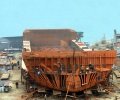
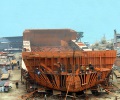
Samsung Heavy Industries announced on the 27th that an LNG carrier equipped with the domestically developed Korean LNG cargo hold (KC-2C), with a capacity of 7,500 cubic meters, has recently completed its first commercial voyage. The vessel was delivered this month and successfully completed its first transportation from Tongyeong to the Jeju Aewol LNG base. The LNG cargo hold is a core facility that safely stores and transports natural gas in an ultra-low temperature liquid state of minus 163 degrees Celsius.
South Korea has maintained a unique first place in the global LNG carrier market based on technological capabilities and productivity. While it is at the world’s top level in all processes from design to construction, cargo hold technology has been an exception. It has relied on the French company *Gaztransport & Technigaz (GTT)*, paying hundreds of billions of won annually in technology usage fees.
The domestic shipbuilding industry has continuously strived to break free from dependence on cargo hold technology. Following HD Hyundai Heavy Industries’ development of the *KC-2B* LNG cargo hold technology with KCLNG Tech in 2023, Samsung Heavy Industries has now joined the domestic production efforts. As a result, the Korean shipbuilding industry has taken another step toward technological independence in the cargo hold sector.
The Achilles’ Heel of the Shipbuilding Industry: Cargo Holds
When liquefied, natural gas reduces in volume to 1/600th, allowing for efficient transportation. However, if the ultra-low temperature is not maintained, it can vaporize, causing a rapid increase in pressure, which in the worst case could lead to an explosion. Therefore, LNG cargo holds must perfectly maintain ultra-low temperatures while ensuring airtightness and insulation, making them a concentration of ultra-high-difficulty technology.
This demanding technology is virtually monopolized by the French company GTT. The membrane-type cargo hold technology held by GTT is applied to most LNG carriers worldwide, especially large vessels. The membrane type involves attaching thin walls made of stainless steel or nickel-iron alloy along the inside of the ship’s hull and placing multiple layers of insulation material behind them.
Domestic shipbuilders have paid approximately 5% of the ship price as technology usage fees, or royalties, to GTT each time they build an LNG carrier. According to data from Democratic Party of Korea Representative Kim Jeong-ho’s office, over 30 years from 1995 to September 2025, the three major domestic shipbuilders (HD Hyundai Heavy Industries, Samsung Heavy Industries, and Hanwha Ocean) paid a total of 7.4097 trillion Korean won in royalties to GTT. The structure where royalty expenditures increase alongside higher LNG carrier order volumes has been an Achilles’ heel for Korean shipbuilding.
The shipbuilding industry has attempted to localize cargo hold technology. In 2004, Korea Gas Corporation and the three shipbuilders began developing a Korean-type cargo hold technology named *KC-1*. However, this cargo hold failed to commercialize as *cold spots (icing phenomena)* continued to occur during operation. Cold spots, where the temperature at a specific point in the cargo hold drops abnormally low, are critical defects that can lead to hull destruction.
Shipbuilding Industry Advances in Localizing Cargo Hold Technology
Samsung Heavy Industries’ developed *KC-2C* overcame these trial-and-error processes by introducing a new secondary barrier and improving construction methods to ensure airtightness and insulation performance. For membrane welding tasks directly exposed to LNG at minus 163 degrees Celsius, they deployed a self-developed *laser high-speed welding robot* to enhance uniformity. Samsung Heavy Industries plans to further advance the technology so that the *KC-2C* cargo hold can be applied to large LNG carriers with a capacity of 174,000 cubic meters, which are highly profitable.
The global LNG carrier market is growing rapidly in line with the expansion of eco-friendly energy. Maritime analysis institutions such as Britain’s Drewry forecast that global demand for LNG carriers will increase by 150 to 250 more vessels by 2030 compared to current levels.
The domestic shipbuilding industry is actively striving for technological independence. HD Hyundai Heavy Industries applied the domestic LNG cargo hold technology named *KC-2B* to the *Blue Whale*, an LNG bunkering ship, in 2023. Bunkering ships are medium-sized vessels that serve as *floating gas stations at sea*, supplying fuel to large LNG vessels. However, in the highly profitable large LNG carrier market, French GTT’s technology still holds a monopolistic position.
A source from the shipbuilding industry stated, “Currently, Korea’s LNG cargo hold technology is being applied to relatively smaller LNG carriers,” adding, “Applying domestic technology to larger vessels, which have higher technical difficulty and safety requirements, and gaining the trust of overseas shipowners will be important tasks moving forward.”
LNG Cargo Hold
It is a type of storage facility that liquefies natural gas to minus 163 degrees Celsius for transportation by ship. Even a slight increase in internal temperature can significantly increase the risk of explosion, making it a facility that requires high-level technology. Most LNG carriers worldwide currently rely on cargo hold technology from the French company GTT, but domestic attempts to localize the technology have continued recently.
Source: The Chosun Daily