Wärtsilä: All-Time High Operating Result And Cash ...
3 months ago

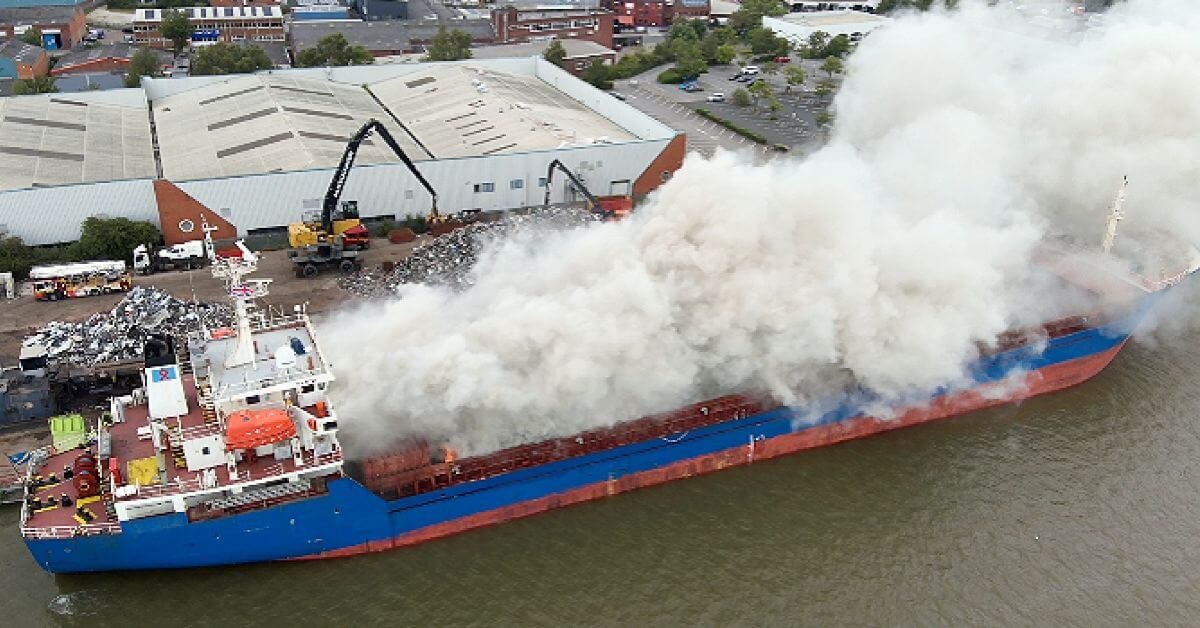

On the morning of 27 June 2025, the Marshall Islands registered bulk carrier Altay was loading scrap metal into its aft cargo hold at Albert Dock, Hull, England.
At 0948, the master observed smoke rising from the cargo and immediately activated the general alarm and called for the shore grab operator to discharge cargo to remove or expose the source of the fire. Meanwhile, the crew mustered and prepared firefighting equipment.
By 0958, two firefighting teams had proceeded to the aft cargo hold to apply water from the port and starboard sides. Additionally, other crew members cleaned the hatch coamings ready for the hatch covers to be closed if necessary. Ashore, the terminal supervisor called the emergency services.
At 1030, several shore fire and rescue service appliances arrived and, after coordinating with Altay’s master, started firefighting. Altay’s crew evacuated the vessel and, from the quayside, the master and chief officer monitored the vessel’s draught and checked the vessel’s stability was not compromised by water from the firefighting.
The smoke and continuously evaporating water created a noxious cloud that drifted over the local area (Figure 1 and Figure 2). At 1215, the fire and rescue service issued a safety alert advising nearby residents and businesses to close windows and doors and remain inside. Consequently, several businesses and two main roads were temporarily closed.
The fire was extinguished in the early hours of 28 June. There were no injuries and there was no loss of life. Over several days, Altay discharged the contaminated firefighting water from the hold into road tankers for disposal. The scrap cargo was discharged and surveyed to check its composition. On 14 July 2025, the ship was surveyed for damage.
Significant heat damage was found to structural steelwork in the aft cargo hold. The Maritime and Coastguard Agency attended and permitted Altay to leave port on 27 July and proceed to a drydock in Turkey for repairs.

Findings
The fire was likely caused by an undischarged battery or other ignition source, causing a spark during loading that ignited combustible material in the scrap cargo.
The scrap cargo had been collected from several sources and the recipient company, The Griffiths Group Limited, expected its suppliers to screen their product to remove hazardous material such as combustibles and batteries.
Deliveries of scrap cargo to Hull were visually checked on arrival. There was no additional sorting and screening facility to ensure that contaminants were not present.
The cargo had been classified as group C[footnote 1] scrap metal under the International Maritime Solid Bulk Cargoes (IMSBC) Code, which did not require the shipper to declare hazard identification and cargo composition. However, the scrap cargo contained hazardous impurities, including batteries, oil drums, and oily residues, which posed a fire risk.
Actions taken
Altay’s operator, Beyaz Denizcilik Ltd Şti, has:
The owner of the cargo loading facility, The Griffiths Group Limited, ceased trading following the incident.
Press Release
Disclaimer :
The information on this website is for general purposes only. While efforts are made to ensure accuracy, we make no warranties of any kind regarding completeness, reliability, or suitability. Any reliance you place on such information is at your own risk. We are not liable for any loss or damage arising from the use of this website.
Disclaimer :
The information on this website is for general purposes only. While efforts are made to ensure accuracy, we make no warranties of any kind regarding completeness, reliability, or suitability. Any reliance you place on such information is at your own risk. We are not liable for any loss or damage arising from the use of this website.
1. eBooks for Engine Department
Master machinery operations, troubleshooting, and safety procedures with expertly written guides tailored for marine engineers. Prevent costly breakdowns and onboard accidents through practical knowledge.
👉 Explore Engine Department eBooks
2. eBooks for Deck Department
Sharpen your seamanship, navigation, and cargo-handling skills with real-world case studies and practical insights designed for deck officers and cadets.
👉Discover Deck Department eBooks
3. eBooks on Electrical Fundamentals & Issues
Understand marine electrical systems, identify potential faults, and prevent onboard electrical failures with step-by-step explanations from industry experts.
4. Pocket Guides for Quick Reference
Compact, handy, and loaded with essential checklists—perfect for on-the-go reference during operations and emergencies at sea.
5. Combo Packs to Save Big
Access multiple expert eBooks at discounted prices. Ideal for professionals seeking complete safety and operational knowledge across various ship departments.
6. Digital Maritime Courses – Learn at Your Own Pace
Upgrade your competence with Marine Insight Academy’s online courses. Learn from industry professionals anytime, anywhere, and become a safer, smarter seafarer.