Wärtsilä: All-Time High Operating Result And Cash ...
3 months ago

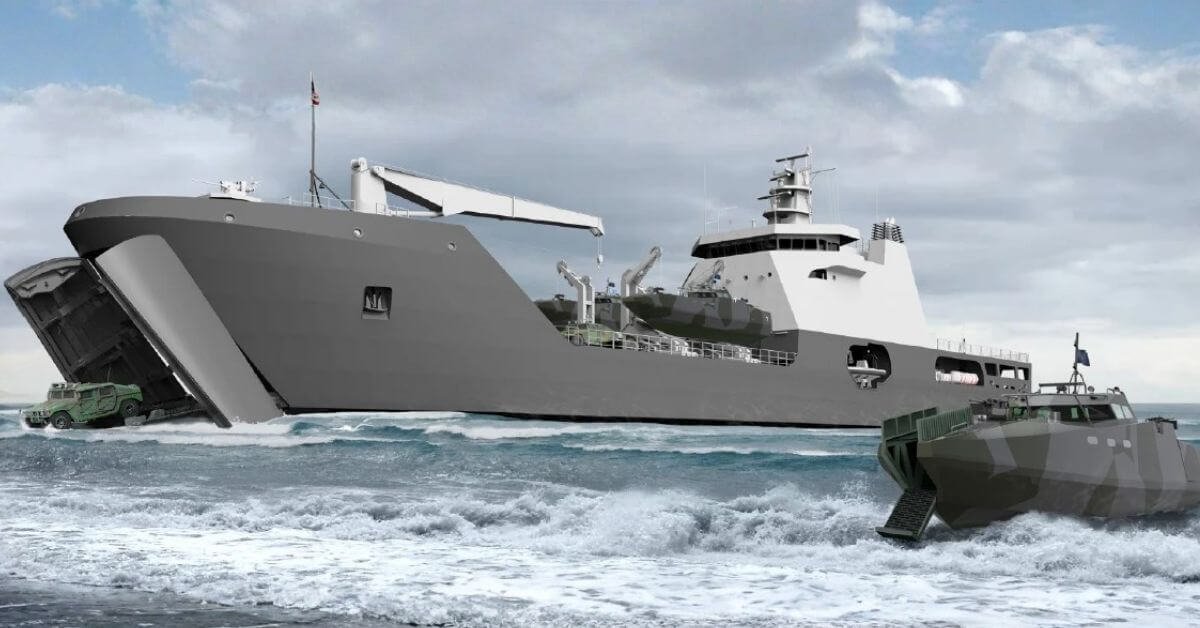
The U.S. Navy has reoriented its Landing Ship Medium (LSM) programme around the Dutch-built LST-100 design, aiming to accelerate production of the McClung-class vessels that will support Marine Corps littoral operations.
Naval Sea Systems Command (NAVSEA) confirmed that it paid Dutch shipbuilder Damen $3.3 million for the LST-100 technical data package, which will now form the basis of the service’s future landing ship fleet.
NAVSEA stated that selecting a mature, non-developmental platform would help shorten acquisition timelines and rapidly field the capability needed for Marine Littoral Regiments operating under the Marine Corps’ Force Design reforms.
The 4,000-ton LST-100 has a range of about 4,000 nautical miles and can carry roughly 250 embarked Marines, according to Damen’s specifications.
U.S. Secretary of the Navy John Phelan, speaking at the Reagan National Defense Forum, said the Navy chose the LST-100 because it is a proven design requiring few, if any, modifications.
He stated that all design requirements will be set before construction begins and added that any change requests during the build phase would be routed directly to him. He said he has set aside a weekly time slot to review any change requests, showing that the Navy intends to keep tight control over the design process.
The Navy is also preparing to acquire the ships under a Vessel Construction Manager (VCM) framework. Under this model, a contracted VCM will hold the design package and select one or more shipyards to construct the vessels.
Phelan mentioned in a recent video announcement that the Navy may use more than one shipyard to build the LSMs. The service plans to buy between 18 and 35 ships to support littoral operations.
The VCM approach has previously been used by the U.S. Maritime Administration, which appointed TOTE Services of Jacksonville, Florida, to manage construction of the five National Security Multi-Mission Vessels. TOTE oversaw the programme and contracted the builds to what is now Hanwha Philly Shipyard.
The Navy still needs approval from Congress before it can use the VCM approach. The draft Fiscal Year 2026 National Defense Authorization Act includes permission for the Navy to use a VCM for the first eight McClung-class ships, as well as for planned light replenishment oilers and other auxiliary vessels. This must become law before the Navy can move forward.
Despite the decision to adopt the LST-100, Gulf Coast-based Bollinger Shipyards is still expected to construct the first vessel, the future USS McClung (LSM-1).
In September, the Navy awarded Bollinger $9.5 million in advanced procurement funding for an LSM based on the Israeli Logistics Support Vessel, which is derived from the U.S. Army’s Frank S. Besson-class 4,200-ton landing ship. With the updated plan, the first LSM will now follow the LST-100 design.
Reference: USNI News
Disclaimer :
The information on this website is for general purposes only. While efforts are made to ensure accuracy, we make no warranties of any kind regarding completeness, reliability, or suitability. Any reliance you place on such information is at your own risk. We are not liable for any loss or damage arising from the use of this website.
Disclaimer :
The information on this website is for general purposes only. While efforts are made to ensure accuracy, we make no warranties of any kind regarding completeness, reliability, or suitability. Any reliance you place on such information is at your own risk. We are not liable for any loss or damage arising from the use of this website.
1. eBooks for Engine Department
Master machinery operations, troubleshooting, and safety procedures with expertly written guides tailored for marine engineers. Prevent costly breakdowns and onboard accidents through practical knowledge.
👉 Explore Engine Department eBooks
2. eBooks for Deck Department
Sharpen your seamanship, navigation, and cargo-handling skills with real-world case studies and practical insights designed for deck officers and cadets.
👉Discover Deck Department eBooks
3. eBooks on Electrical Fundamentals & Issues
Understand marine electrical systems, identify potential faults, and prevent onboard electrical failures with step-by-step explanations from industry experts.
4. Pocket Guides for Quick Reference
Compact, handy, and loaded with essential checklists—perfect for on-the-go reference during operations and emergencies at sea.
5. Combo Packs to Save Big
Access multiple expert eBooks at discounted prices. Ideal for professionals seeking complete safety and operational knowledge across various ship departments.
6. Digital Maritime Courses – Learn at Your Own Pace
Upgrade your competence with Marine Insight Academy’s online courses. Learn from industry professionals anytime, anywhere, and become a safer, smarter seafarer.