Korea and US launch shipbuilding tech centers in W...
2 hours ago

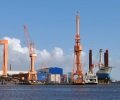

On the afternoon of the 17th, about 20 employees wearing safety helmets at the large assembly workshop (yard) of HD Hyundai Heavy Industries’ Ulsan Shipyard shouted the slogan, “Safety, good!” More than 15 of them were foreign workers from Thailand and other countries. In the storage lockers at the workshop, name tags of foreign workers such as ‘Ijis’, ‘Duminda’, and ‘Yadehi’ were mixed with those of Korean workers. It is not uncommon to see workers conversing with translation apps open at the site. The same applies to the work sites of Samsung Heavy Industries and Hanwha Ocean on Geoje Island, South Gyeongsang Province. ‘Multinational shipyards’ have now become an irreversible reality.
Foreign labor supply, which has been a key pillar of the shipbuilding industry’s revival in recent years, is facing a potential crisis. This is because the government is considering abolishing the ‘foreign visa quota’ system it introduced to address labor shortages in the shipbuilding sector. The shipbuilding industry is protesting, stating, “If even foreign workers, who have maintained the front lines in place of domestic workers avoiding 3D jobs, are cut off, it will be impossible to properly handle the secured order volumes.”
On the 19th, the Ministry of Employment and Labor’s Foreign Labor Policy Deliberation Committee will discuss whether to abolish the ‘E-9 (Non-Professional Employment) Shipbuilding Industry-Dedicated Quota.’ It is known that the government has effectively decided to proceed with the abolition.
The E-9 shipbuilding quota, which allocates a separate portion for the shipbuilding industry from the E-9 visa (130,000 this year) for non-specialized foreign workers, was temporarily introduced until the end of this year in response to the severe labor shortage in the shipbuilding industry in 2023. In 2023, the first year of its introduction, and last year, 5,000 people were allocated each year, and this year, a quota of 2,500 was given.
It is reported that approximately 80% of foreign workers in shipyards were hired through this system. Since the introduction of this system, the proportion of foreign workers in the three major domestic shipbuilding companies (HD Korea Shipbuilding & Offshore Engineering, Hanwha Ocean, and Samsung Heavy Industries) surged from 5% (4,640 people) in 2021 to 18% (20,200 people) last year. The E-9 shipbuilding quota has also served as a ladder for foreigners to transition to skilled workers (E-7) in the shipbuilding field.
The Ministry of Employment and Labor stated, “Shipyard manpower has already been sufficiently replenished, and the current quota exhaustion rate is only about one-third, making it difficult to justify an extension.” The labor sector and local politicians are also advocating for the abolition of the quota. The rationale is ‘reverse discrimination against domestic workers’ and ‘lack of trickle-down effect.’ Shipbuilding company unions argue, “Since companies can always hire foreigners paid at the level of Korea’s minimum wage, the big three shipbuilders are neglecting efforts to improve wages and treatment for shipyard workers.” They claim that low-wage foreign workers are encroaching on domestic jobs and blocking wage increases across shipyards. On the 24th of last month, Geoje Mayor Byun Gwang-yong met with Minister of Employment and Labor Kim Young-hoon and emphasized the need to reduce foreign worker visas, stating, “The influx of foreign workers is reducing youth employment and decreasing skilled jobs.”
Local commercial districts are also strongly dissatisfied. Although the number of foreign workers in Geoje has tripled over three years (from 5,410 to 15,790), local consumption has not revived because they remit their salaries to their home countries. In the second quarter of this year, Geoje’s commercial district vacancy rate was 35.1%, ranking second nationwide.
◇ Industry: “Cannot Handle Orders Without Them”
The shipbuilding industry, struggling with recruitment difficulties, continues to express concerns, stating, “There is still a shortage of manpower.” Thanks to foreign workers taking on arduous tasks such as welding and painting, which domestic workers avoid, the shipbuilding industry has secured orders worth 135 trillion Korean won, with volumes guaranteed until 2028.
In the case of HD Hyundai, the company has recently been expanding overseas operations by building local shipyards in Saudi Arabia, Peru, India, and collaborating with U.S. companies on joint warship construction. As the scope of expansion grows, the demand for manpower increases accordingly, meaning the need for foreign workers can only grow further than it is now.
The industry’s greatest concern is manpower attrition amid accumulated orders. If the shipbuilding-dedicated quota is abolished and integrated into general manufacturing visas, there is a high possibility that foreign workers will move en masse to general factories with less intense work instead of the demanding and dangerous shipyards.
Shipbuilding companies believe that even if the foreign worker quota is reduced, young people are unlikely to come to the region because domestic workers avoid sectors like welding and painting. An industry source said, “Reducing foreigners does not mean young people will come to the tough shipyards,” adding, “The shipbuilding quota is merely the minimum safety device to keep foreign manpower tied to shipyards.” Particularly, next year, the construction of container ships, which require more labor than LNG carriers, is expected to increase, so the impact of a foreign labor shortage will be even greater. The industry appeals that the ‘K-Shipbuilding Renaissance’ initiated by the MASGA (U.S. Shipbuilding Reconstruction) project, a Korea-U.S. shipbuilding cooperation project, is impossible without foreign manpower.
☞ E-9, E-7, and Regional Visas
E-9 (Non-Professional Employment) Visa: This visa is issued to foreign workers in simple labor sectors such as manufacturing and agriculture under the government’s Employment Permit System. Family accompaniment is restricted, and movement between workplaces is regulated.
E-7 (Specific Activities) Visa: This visa is granted to outstanding foreigners in professional fields designated by the Ministry of Justice. It strictly applies academic and career requirements.
Regional Visa: This system allows the Ministry of Justice to issue visas to individuals recommended by local governments facing population decline, enabling them to reside and work in those regions. It is characterized by relaxed visa requirements contingent on regional settlement.
Source: Chosun