Korea and US launch shipbuilding tech centers in W...
2 hours ago

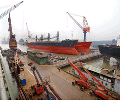

On December 18 of last year, inside the small assembly process area at HD Hyundai Heavy Industries’ Yongyeon Factory in Ulsan’s Nam-gu District. Dozens of 1.5-meter-long steel materials were lined up in two columns, 80 centimeters apart, on the workshop floor. These are core components for ship floors.
Four ceiling-mounted robots glided over the materials, ceaselessly maneuvering welding torches, sending sparks flying in all directions. In a human-operated setting, workers would have to bend their backs in the narrow gaps between materials, sweating profusely. But the robots tirelessly forged “iron art.”
Small assembly is the initial process of assembling small ship structures. While humans take 15 minutes to weld a 1.2-meter joint, robots complete it in just 5 minutes. In November 2024, robots were introduced to this site, where six skilled workers previously welded 500 metric tons per month. Now, four robots operate from 8 a.m. to 4 a.m. the next day, processing 900 metric tons monthly—a productivity increase of over 80%. Currently, the system is in the phase of collecting big data to enable AI (artificial intelligence) to understand material properties, but it will soon advance to a stage where AI autonomously determines optimal welding paths.
A wave of M.AX (Manufacturing AI Transformation) is sweeping through South Korea’s manufacturing sector. Shipbuilding has long been considered a “barren land for automation” due to the massive size of ships, complex processes, and harsh outdoor conditions. The fact that shipyards are now undergoing AI transformation signals that M.AX is possible across all manufacturing industries. With AI-powered robots integrated into rugged and coarse shipbuilding processes, 24/7 dark factories—facilities operating without human intervention—are expected to soon become a reality. South Korea’s manufacturing sector, facing crises due to aging populations and labor shortages, is finding a way forward through M.AX.
“Creating a Shipyard Version of the Dark Factory”
HD Hyundai’s shipyards are equipped with approximately 200 robots, including 50 industrial robots and 150 collaborative robots. While there was initial resistance from workers in 2019, fearing job losses, a coexistence principle has since emerged: “robots handle dangerous tasks, humans manage precision.” Some AI-advanced processes now require minimal human intervention, approaching the stage of year-round dark factories.
The lug manufacturing process, the world’s first fully automated shipbuilding process, is a prime example. Ships are assembled from hundreds of blocks, and lugs—components that act as hooks when moving blocks with cranes—are required, around 2,000 per ship. Until recently, skilled workers produced lugs manually.
Now, 3D vision AI recognizes the position and shape of parts with 0.1-millimeter precision, and robots independently handle the entire process—cutting, aligning, and welding. Even material transport, previously done by forklifts, and post-use lug maintenance are now automated. HD Hyundai expects annual cost savings of approximately 500 million Korean won from the lug process alone. Executives from the U.S. shipbuilder Edison Chouest Offshore (ECO) recently visited the site and expressed admiration.
Currently, only three high-demand lug types are automated, but the plan is to expand robotic production to 43 types by 2026. Yoon Dae-gyu, an executive vice president at HD Hyundai Heavy Industries, said, “We aim to build a shipyard that operates 24/7 by enhancing automation. We are also developing humanoid robots specialized for shipbuilding.”
AI Revolution Begins in the Roughest Industries
Beyond HD Hyundai, the entire shipbuilding industry is turning to robots and AI to solve labor shortages and technical succession challenges. Samsung Heavy Industries is collaborating with Rainbow Robotics to develop mobile dual-arm and quadruped robots, while Hanwha Ocean plans to invest 300 billion Korean won by 2030 to build a Smart Yard—an intelligent shipyard powered by data, robots, and AI.
In standardized industries like steel and automotive, the spread of M.AX is even faster. POSCO Group has begun joint development of humanoid robots for high-risk processes in steelworks. Boston Dynamics’ “Atlas,” nurtured by Hyundai Motor Group, will make its U.S. debut this month. Korean factories, once filled with the smell of sweat, are now evolving into “intelligent industrial fortresses.”
M.AX (Manufacturing AI Transformation)
An acronym for Manufacturing AI Transformation. It refers to revolutionizing the entire production process by integrating AI technology into manufacturing. Aimed at addressing labor shortages due to low birthrates and aging populations, as well as intensifying global manufacturing competition, M.AX goes beyond simple automation. Its goal is to maximize productivity by enabling AI to make autonomous decisions and optimize processes.
Source: The Chosun Daily