Baltic Dry Index climbs to 2567 up 44 points
3 hours ago

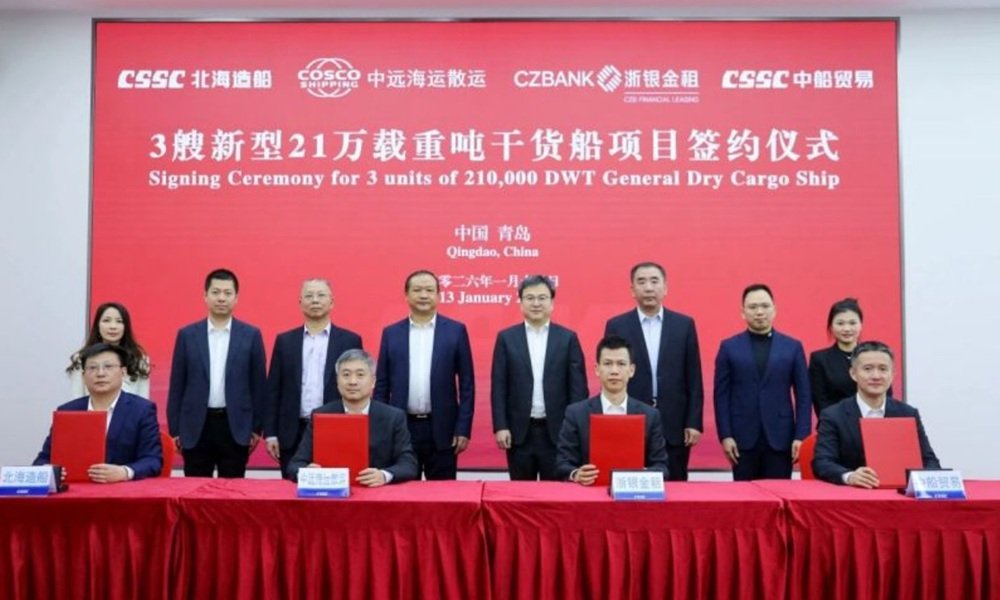
China’s COSCO Shipping Bulk has moved to blur the traditional lines between dry bulk and liner shipping, ordering a series of container-capable newcastlemax bulk carriers in a deal that underlines how cargo flexibility is becoming a strategic asset. Busy COSCO has also revealed a major containership ordering spree, lining up 18 newbuildings worth about $2.7bn.
CSSC Qingdao Beihai Shipbuilding has been tasked with building three 210,000 dwt bulk carriers featuring methanol- and ammonia-ready designs and the ability to carry containers alongside bulk and general cargo.
The vessels have been designed by the Shanghai Merchant Ship Design and Research Institute (SDARI) and will be classed by China Classification Society. At nearly 300 m in length and with a 50 m beam, the ships retain full newcastlemax dimensions while adding container intake to what has traditionally been a pure bulk carrier segment.
The contract was signed by COSCO Shipping Bulk together with CSSC Beihai Shipbuilding, CSSC Trading and Zheshang Financial Leasing, reflecting the scale and financial backing behind the project.
The design marks a step-change for the 210,000 dwt platform, long a flagship product for Beihai Shipbuilding, which has built a dominant position in the global newcastlemax market and continues to lead in orders for the vessel type. The yard recently secured further contracts from Seacon Shipping Group, reinforcing its grip on the segment.
For COSCO, the deal is part of a broader push to expand and modernise its newcastlemax fleet. The group has also been linked as end operator to four 210,000-dwt newbuildings at Dalian Shipbuilding Industry Co, marking its second newcastlemax ordering wave of 2025. Earlier in the year, COSCO approved orders for ten similar units at COSCO Shipping Heavy Industry Zhoushan and CSSC Qingdao Beihai, with deliveries due by the end of 2028.
While container intake on bulk carriers may once have looked like a niche feature, the concept has clear precedent. During the pandemic’s distorted freight markets, cargoes migrated across vessel classes in ways rarely seen before. Containers were loaded onto bulk carriers, logs were shipped on newcastlemaxes, and even cars found their way onto pulp carriers. In 2022, Star Bulk became one of the first cape owners to secure class approval to carry containers, while Swire Bulk and others actively moved boxes on dry bulk tonnage. With liner capacity scarce and charter markets tight, owners adapted stowage plans to chase high-paying cargo — a lesson in flexibility that COSCO now appears to be baking directly into its newbuild designs.
COSCO, the world’s largest shipowner, has a history of blurring vessel segments. Back in 2022, for instance, it started moving cars in a pulp carrier having developed a foldable car frame where vehicles can then be stacked into ships not traditionally associated with the movement of automobiles.
COSCO has also confirmed a major containership ordering spree, lining up 18 newbuildings worth about $2.7bn as China’s state-run shipping group adds both scale and fuel optionality to its fleet.
In regulatory filings, COSCO said it has ordered twelve 18,000 teu LNG dual-fuel containerships at CSSC’s Jiangnan Shipyard, alongside six 3,000 teu conventionally powered vessels at COSCO Zhoushan Shipyard.
The twelve LNG-capable ships are priced at just under RMB1.4bn apiece, or around $200.75m per vessel, putting the total contract value at RMB16.8bn. Deliveries are scheduled across 2028 and 2029.
The order marks COSCO’s first move into LNG as an alternative marine fuel. Until now, the group has focused on methanol alongside conventional propulsion.
According to Alphaliner, the vessels are based on Jiangnan’s in-house 18,000 teu LNG design. The yard already has a dozen ships of the same design on order from COSCO’s Ocean Alliance partner CMA CGM, also due for delivery in 2028 and 2029. Jiangnan has a long track record with COSCO, having previously delivered 5,100 teu, 4,700 teu and 21,000 teu container ships to the group.
Alongside the LNG order, COSCO has also signed contracts for six 3,000 teu container vessels at COSCO Zhoushan Shipyard. Each ship is priced at just under RMB330m, or about $47.3m, with deliveries expected from mid-2028 through the end of the year.