OOCL challenges FMC court system after $45m ruling
5 hours ago

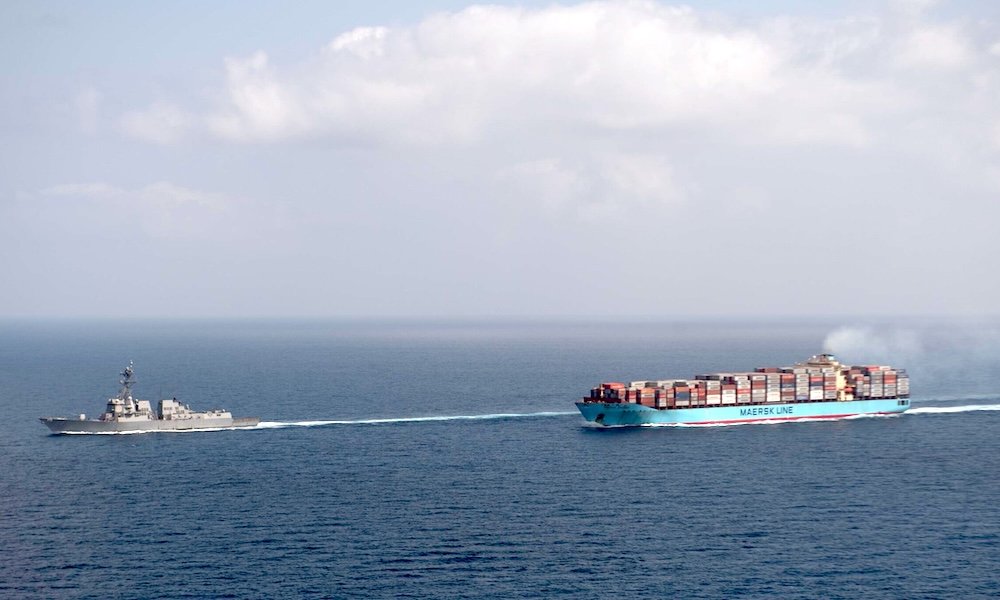
News yesterday that Danish carrier Maersk is taking its first structural step back into the Red Sea has analysts voicing caution that this could mark the start of big shift from the Cape of Good Hope through the Suez with a significant knock-on effect for the bottom lines of global liners in 2026.
Maersk, the world’s second largest liner, announced yesterday it is rerouting its MECL service, connecting the Middle East and India with the US east coast.
The structural return kicks off with the Cornelia Maersk, an 8,650 teu Danish-flagged vessel, departing Oman’s port of Salalah on January 26, while the Maersk Detroit will become the first eastbound ship back through Suez on February 3.
The decision follows two initial trial sailings through the corridor of the Maersk Sebarok and the Maersk Denver and forms part of a gradual, stepwise approach to resuming East–West navigation via the Red Sea.
Shipping analysts at SEB, a Scandinavian bank, said they expect other ocean carriers to follow suit.
“Despite potential first-mover advantage and a short-term rate spike from congestion, our expectation is that rates will deteriorate from the effective release of supply having a significant impact on supply/demand,” SEB suggested in a note to clients.
Peter Sand, who heads up research at container rate platform Xeneta, observed that Maersk has been the most risk averse out the major carriers regarding a return to the Red Sea, hence his description of yesterday’s news as a “turning point”.
“This does not mean an immediate large-scale return of container shipping to the Red Sea region,” Sand pointed out, in conversation with Splash today.” Depending on how quickly carriers want to move, it could take three to five months for schedules via the Suez Canal to be fully reinstated.”
Sand predicted significant disruption and port congestion during that time as services adjust to new routes and transit times.
A large-scale return to shorter sailing distances via Suez Canal would effectively free up 6-8% of global container shipping capacity, according to Xeneta data.
“The implications of this are clear for both carriers and shippers, with overcapacity placing significant downward pressure on freight rates,” Sand said.
“The return to the Suez Canal route is one of this year’s key influencing factors for capacity, freight rates, transit times and fuel consumption,” said Philip Damas, managing director of shipping consultancy Drewry.
A report from Danish consultancy Sea-Intelligence last month showed the demand in Q3 of each year on the basis of a Red Sea opening in early 2026 followed by a three to four month transition period of operational congestion, as well as assuming a general 3% demand growth globally in 2026.
In this case, Sea-Intelligence sees global demand in teu*Miles decline by 12% in Q3 this year (see chart below).
Providing a counterargument to the narrative, Hua Joo Tan, co-founder of Asian container shipping consultancy, Linerlytica, argued that providing customers with a faster service is not the primary consideration for Maersk.
The first two test voyages Maersk ran had a 29-day transit time from Salalah to Newark, no different from a Cape routing despite using the shorter Suez route, according to data compiled by Linerlytica.
“There is no advantage for customers as far as transit time is concerned. The proforma schedules for the subsequent sailings show a similar transit time.,” Tan told Splash.
The Maersk news comes as freight rates around the world are coming under pressure. The Drewry World Container Index (WCI) decreased yesterday 4% to $2,445 per feu, mainly due to a drop in rates on the Transpacific and Asia–Europe trade routes.