Korea and US launch shipbuilding tech centers in W...
3 hours ago

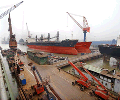

The Takaichi administration in Japan, which secured a landslide victory in the early general election, is prioritizing shipbuilding industry reconstruction as a key task to build a “strong Japan,” drawing global attention from the shipbuilding sector. Like the United States, Takaichi’s Japan views the shipbuilding industry through the lens of economic security. With neighboring China challenging maritime hegemony, Japan—surrounded by sea on all sides and with low self-sufficiency rates in energy and food—also sees strengthening shipbuilding as essential for maritime expansion.
The Liberal Democratic Party (LDP) stated ahead of the early general election last month, “Japan’s global share of shipbuilding volume accounted for about 40% in the 1990s but has fallen to 8% (2024) due to the rise of China and South Korea,” and added, “We will work with the government to regenerate the shipbuilding industry.” With the election victory, there are prospects that shipbuilding will be fostered as a core industry at the government level.
In the global shipbuilding industry, over the past four to five years, a structure has been maintained where China dominates more than half the market, South Korea holds around 20–30% share, and Japan accounts for slightly over 10%. Attention is focused on whether the shipbuilding industry that the “strong Japan” aims to develop will disrupt this status quo.
Shipbuilding Industry Elevated to ‘Economic Security’
First, the Japanese government set a goal through the “Shipbuilding Industry Regeneration Roadmap” announced late last year to double annual shipbuilding volume to 18 million tons by 2035. Additionally, through the LDP’s early general election pledges, shipbuilding was designated as one of 17 national strategic industries, alongside AI (artificial intelligence), semiconductors, and others.
call to action icon
The key point is that the government plans to invest a combined public-private total of 1 trillion yen (approximately 9.3 trillion Korean won) over the next 10 years and is even considering establishing a “state-owned shipyard” if necessary. The 1 trillion yen-scale fund will be formed with the government and the shipbuilding industry each contributing approximately 380 billion yen and 350 billion yen by 2035, with the remainder supplemented by public finance. Funds will be gradually invested in expanding shipyard infrastructure, restarting operations, and establishing new facilities. The goal is to fully operationalize automated facilities starting in 2028 and significantly increase production based on expanded docks by 2034.
The Takaichi administration is also planning a so-called “All Japan” strategy that links shipbuilding with shipping and logistics policies, targeting the next-generation ship market. This structure involves Japanese shipowners investing in shipyards to jointly develop next-generation ships and then reordering these ships from domestic shipyards—reclaiming orders previously placed with South Korea or China. Three major Japanese shipping companies have already invested in next-generation ship design companies created by Imabari Shipbuilding and others, putting this strategy into motion.
To support this, the government established the “National Dock” concept last year. This model is close to a “state-owned shipyard,” where the government directly constructs docks or modernizes aging facilities to lease them to private shipbuilders.
Currently, Japan’s steel prices, which account for about 30% of shipbuilding costs, are approximately 20% higher than those in China, leading to lower price competitiveness. As the Takaichi administration plans to actively implement tax reduction policies, there are prospects that reducing taxes on key materials and parts industries, such as steel, will ultimately lower shipbuilding costs.
◇Aftereffects of Shipbuilding Industry Downsizing… Skepticism About Rapid Reconstruction
On the other hand, skepticism about reconstruction remains. There are doubts about whether Japan can quickly overcome labor shortages, aging population, and declining productivity within a few years. Japan also experienced a nearly decade-long global shipbuilding slump since the mid-2010s, exacerbating these issues. Traditional shipbuilders like Mitsubishi Heavy Industries have successively scaled down operations and closed docks. As a result, Japan is evaluated to have lower shipyard production capacity than not only China but also South Korea.
Yukio Okumura, president of Japanese shipbuilder Tsuneishi Shipbuilding, said in an interview with Japanese economic magazine Nikkei Business last month, “Setting goals is good, but considering demand trends, securing manpower, and the time required for facility expansion, I don’t think the goal of doubling shipbuilding volume by 2035 is feasible.” There are also criticisms in Japan that “this is a strong political message character, conscious of U.S. pressure emphasizing the shipbuilding industry.”
Source: The Chosunilbo