Marinakis’ CCEC partners with BGN on LNG vessel ve...
1 day ago

Washington and Tokyo have unveiled the first three industrial projects in the US under a $550 billion deal struck last summer, where Japan exchanged infrastructure investment in the US for lower tariffs.
On February 17, 2026, both governments announced phase one projects with a combined worth of $36 billion. The biggest of the projects is a $33 billion, 9.2 GW natural gas power plant in Ohio, led by Japan’s SoftBank Group, while Hitachi, Toshiba and Mitsubishi Electric have expressed interest.
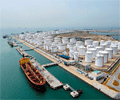
This project was described by President Donald Trump on his Truth Social platform as “the largest in history”. The other two projects are a $2.1 billion deepwater crude oil export facility in Texas and a $600 million synthetic industrial diamond factory in Georgia.
In contrast, South Korea’s Ministry of Trade, Industry and Energy (MOTIE) on 10 February said the government convened a cross‑government meeting to manage escalating trade uncertainty with the US following President Donald Trump’s 26 January social media post of plans to raise tariffs on autos, lumber and pharmaceuticals to 25% from 15% as he claimed Seoul had failed to fully implement a trade agreement.
Earlier comments this year by Finance Minister Koo Yun‑cheol indicated that a core component of the agreement – investments of $350 billion in US strategic‑sector projects – was unlikely to begin in 1H 2026 due to currency weakness and domestic economic conditions.
Seoul says it is maintaining close contact with US Trade Representative (USTR) office to ensure non‑tariff provisions remain on track. No new details were provided on LNG‑related components of the broader trade framework, which could include investments in the proposed Alaska LNG project
ENERGY CALCULATIONS
The geography of the three Japanese projects is not accidental. Ohio and Georgia are crucial swing states for November’s midterm elections, Nikkei reported, and energy jobs in swing states are precisely the kind of visible, measurable policy outcome that the Trump administration wishes to deliver before midterms.
Beyond domestic gains, the materialization of the Japan-US Strategic Investment Initiatives validates Trump’s tariff-as-leverage doctrine and potentially further accelerates the displacement of Russian and Middle Eastern LNG in Japan’s import mix.
Russia’s position is the most directly threatened by the deal’s energy provisions. The Gazprom-operated Sakhalin Energy Sakhalin-2 LNG plant continues to operate, but Japanese investment into American gas assets is increasingly pointing to a withdrawal to it.
Even without a formal exit, Japan’s increasing US LNG commitments reduce the strategic value of Sakhalin-2 as leverage.
A Japanese exit from Sakhalin could also benefit the rival Chinese energy market with extra Russian supply at low prices while Japan scrambles for replacement.
Japan currently accounts for roughly 18% of Russia’s total LNG exports, which would likely flow to China if Japan drops out, deepening Beijing’s energy partnership with Moscow and giving China additional control over a strategic energy commodity in the Indo-Pacific region.
In a wider Japan energy security buildout, alternative supplies are coming into place.
Japan’s Ministry of Economy, Trade and Industry (METI) concluded a memorandum of understanding (MoU) cooperation with Japanese buying consortium JERA and state‑owned QatarEnergy to enable additional LNG supply to Japan in times of emergency, with the aim of ensuring Japan’s stable energy supply, according to a news release on 4 February.
The MoU stipulates that if METI determines that Japan’s stable domestic energy supply is at risk – due to factors such as global LNG market tightness or major natural disasters in Japan – the Japanese government may request additional LNG supply from QatarEnergy, and the parties will consult on specific response measures. No specifics were mentioned.
As reported, JERA has signed a sales and purchase agreement (SPA) with QatarEnergy for JERA to buy approximately 3mtpa of LNG from Qatar for 27 years from 2028 on a DES basis (Delivered-Ex-Ship), JERA said in a statement on 3 February. Analysts are speculating about the terms of the deal and if restrictive resale clauses are part of the agreement.
Japan is diversifying its LNG purchases for security of supply; the deal follows another SPA around three weeks ago that saw JERA sign a five-year commitment to buy approximately 0.2mtpa of LNG from Australia’s Woodside during peak Japan winter starting in 2027.
JAPAN’S UPSTREAM BUILDOUT
For Japan, the long-term implications of the US LNG alignment extend well beyond the immediate trade deal discounts.
The import-dependent country’s 7th Strategic Energy Plan targeted a fossil fuel self-development ratio – the share of imports from Japanese-owned assets – to rise from 37% in 2023 to over 50% by 2030, to above 60% by 2040.
American upstream investments are central to achieving that target. The pace of Japanese energy investment in the US has accelerated sharply in recent years.
Japan’s largest power producer JERA holds a 25.7% interest in Freeport LNG in Texas, a stake valued at around $2.5 billion.
In June 2025, JERA announced five new long-term agreements totaling 5.5 million tonnes per year with NextDecade, Commonwealth LNG, Sempra Infrastructure, and Cheniere. These deals cover 20 years, all priced to the US Henry Hub benchmark with FOB clause and no destination restrictions.
Combined with existing Freeport and Cameron LNG contracts, US supply could account for roughly 30% of JERA’s long-term LNG portfolio by 2035, up from around 10% today by JERA’s own estimates.
Mitsubishi Corporation moved even more aggressively. In January 2026, it announced the acquisition of Aethon Energy’s Haynesville Basin assets in East Texas and Louisiana for $7.53 billion, including assumed debt – the largest Japanese purchase of American shale assets on record.
The deal adds approximately 2.1 bcf of gas per day of production capacity, which equals Mitsubishi’s total existing LNG production across its global portfolio and therefore doubling output. Mitsubishi framed the acquisition as building an integrated natural gas value chain in North America, from upstream production through pipeline to Gulf Coast LNG export terminals.
Tokyo Gas has pledged to direct at least half of its $2.3 billion overseas investment budget over the next three years toward the US. JAPEX, better known for assets in Indonesia, Iraq, and Norway, spent $1.3 billion on Colorado and Wyoming upstream assets. Osaka Gas, Mitsui, and smaller utilities all hold offtake positions in various Gulf Coast LNG projects.
The aggregation of these moves represents a structural shift: Japan is no longer merely a buyer of American LNG – it is becoming embedded in the upstream value chain itself. But so far notably absent from firm commitments is the Alaska LNG project.
The US-Japan Strategic Trade and Investment Agreement is, on its surface, a tariff negotiation.
But its energy provisions reveal something more consequential: an LNG supply architecture that ties Japan’s energy security to American upstream production, export infrastructure, and by extension American geopolitical priorities in the Indo-Pacific.
Source: By Paula Xiao, ICIS, https://www.icis.com/explore/resources/news/2026/02/20/11181221/us-japan-trade-deal-indicates-changing-asian-energy-order/