Turkey’s Yasa revealed as buyer behind pair ...
24 hours ago

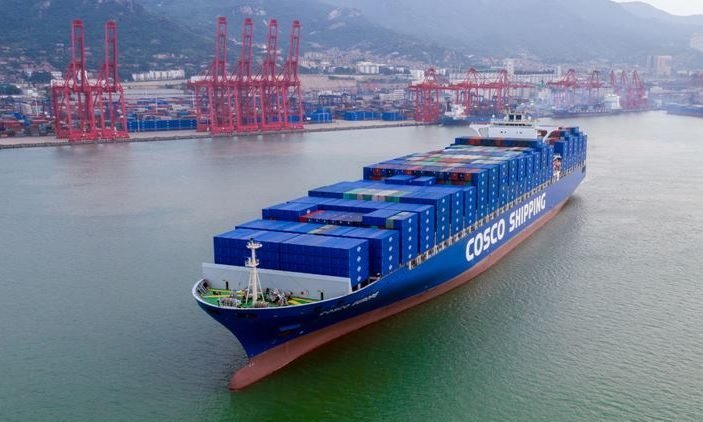
The container shipping industry’s response to the fourth week of the Persian Gulf war shifted in a more optimistic direction on Wednesday as China’s state-backed COSCO Shipping Lines announced the resumption of new booking services for ordinary freight containers from the Far East to the Middle East, effective immediately — reversing a suspension imposed on March 4 when escalating conflict and Hormuz restrictions made the trade commercially unworkable.
COSCO’s return covers the UAE, Saudi Arabia, Bahrain, Qatar, Kuwait and Iraq. The move follows Chinese Foreign Minister Wang Yi’s call to his Iranian counterpart Abbas Araqchi on March 24, urging Tehran to engage in negotiations with Washington as soon as possible to end the war — a signal that Beijing is applying diplomatic pressure to reopen the region’s trade arteries on which its own state carriers depend.
South Korea received its own qualified relief when Iran’s ambassador to Seoul, Saeed Koozechi, confirmed at a press conference today that South Korean vessels may transit the Strait of Hormuz — but only with prior coordination with Tehran.
The Gulf is a geographical cul-de-sac
“There are no problems with the vessels,” Koozechi said through an interpreter. “But in order for them to pass through, you need coordination, prior consultations with the Iranian military and government.”
BIMCO chief shipping analyst Niels Rasmussen said today that there are around 130 containerships, totalling about 1.5% of the global fleet’s capacity, stranded in the Gulf. Rasmussen estimates that around 3% of global container volumes can no longer move, directly impacting approximately 5% of global ship demand. Because many Gulf-calling vessels also serve Pakistani and Indian ports, nearly 10% of the global fleet has been impacted overall.
BIMCO’s modelling presents two scenarios — one assuming the strait remains effectively closed indefinitely and one assuming imminent resumption — but Rasmussen was sober about the outlook in either case. “Whether the Strait of Hormuz remains effectively closed or not, we expect a slight weakening of the global supply/demand balance in 2026 and 2027. However, if transits do not resume, liner operators will face substantial extra costs due to higher oil prices while cargo volumes will be reduced,” he said in a container market update.
The structural nature of the problem was articulated by Turloch Mooney, global head of port intelligence and analytics at S&P Global. “Unlike the Red Sea, there is no maritime alternative to the Gulf’s major hubs,” he warned in a recent social media posting. “Short-term feeder relays aren’t a solution; they are simply bottleneck migration.” Mooney described the Gulf as a geographical cul-de-sac, coining the phrase ‘network bifurcation’ to characterise a market in which schedule reliability has become “a relic of the past.”
Despite the turbulence, freight rates have begun to ease. Linerlytica reported that the initial upward pressure from Middle East disruptions has been offset by the redeployment of surplus vessels displaced from their regular Gulf services into alternative routes. Capacity utilisation across key tradelanes remains well below the level needed to sustain the mid-March rate hikes carriers had announced, forcing those increases to be rolled back. Early indications on new transpacific contracts suggest rates have held broadly at last year’s levels, though shippers face higher bunker surcharges.
On the operational front, Hapag-Lloyd announced it is making live tracking for both dry and reefer containers freely available to customers with cargo in the region, giving shippers real-time visibility of their cargo’s whereabouts amid the continuing uncertainty.