Valenciaport awards the concession for a renewable...
3 hours ago

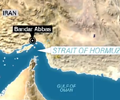
Most EMEA port operators have sufficient headroom to absorb the implications of a prolonged Iran conflict at their current ratings, Fitch Ratings says. Exposure to Middle East volumes varies, being highest at DP World and Abu Dhabi Ports (ADP) and minimal at ABP and Boluda.
Our adverse scenario assumes a three-month closure of the Strait of Hormuz, followed by a gradual re-opening, oil prices averaging USD100/barrel in 2026, and some pressure on refinancing costs. The prolonged closure of Hormuz would trigger higher war-risk premiums, higher energy prices and rising inflation. Many costs are passed on to cargo owners, but sustained inflation may weaken containerised trade demand. We also expect port congestion to worsen as vessels avoiding high-risk zones arrive without prior scheduling.
We assess the overall impact of this adverse case on rated EMEA port operators as medium to low, mitigated by globally diversified operations, long-term contracted lease revenues and tariff flexibility, strong liquidity buffers, and medium-term bullet maturities.
Global impacts remain second order, transmitted primarily through energy price volatility and network disruption rather than sharp throughput declines. Major carriers have diverted most services to alternative ports and suspended efforts to resume Asia-Europe services through the Red Sea, although Suez sailings continue for the Saudi market.
DP World and ADP can absorb the adverse scenario, with their ratings remaining resilient despite material Middle East exposure.

Global diversification provides natural hedges, while flexibility in capital allocation and shareholder distributions, combined with operating leverage (70%-75% variable costs) and fuel representing less than 5% of operating expenses, supports rapid cost adjustment. Both companies are well positioned to capture rerouting demand and benefit from increased storage revenues.
Jebel Ali accounts for about 27% of DP World’s volumes. Origin-and-destination cargo would be lost, but transhipment flows may reroute to nearby terminals. Revenue offsets may include storage revenues and stranded cargo. Cargo, particularly commodities, continues to move east of the strait, where passage remains open, with rerouting to the Indian subcontinent. At end-2025, DP World held about USD4.4 billion in cash and USD400 million in undrawn credit facility.
ADP’s rating is linked to the government of Abu Dhabi, and Fitch expects a small impact on public finances from the Strait’s closure, given the anticipated large budget surplus. ADP’s UAE terminals remain operational, with limited impact on its maritime and shipping segment, despite reduced port calls. Fixed concession fees at Khalifa Port, increased transhipment volumes and government support provide downside protection.

Vessels are being redirected to Fujairah and Khorfakkan instead of Khalifa Port, with Karachi an additional alternative, and the government is absorbing incremental operating costs. ADP maintains strong liquidity, with a USD1.0 billion revolving credit facility maturing in 2029, USD750 million in cash and no material debt maturities within two years.
ABP operates a diversified landlord model, with over 50% of revenue contractually fixed or subject to minimum guarantees, and has no vessels calling at Southampton or Immingham directly from the Middle East.
Boluda has no operations in the Gulf, with its nearest port in Egypt representing less than 1% of revenue. If the conflict undermines expectations of a large-scale return to Red Sea routings in 2026, continued Cape diversions could be positive for Boluda given its presence in West African ports. Fuel represents about 13% of Boluda’s costs and roughly 65% of contracts have pass-through mechanisms, although there is a temporary lag in recovering increased fuel prices.
A prolonged regional conflict would affect volumes at eastern Turkish ports operated by Limak and Mersin. Limak’s limited pre-conflict rating headroom may face additional stress, although a six-month debt service reserve account provides liquidity support. Mersin’s rating is constrained by Turkiye’s ‘BB-’ Country Ceiling, and its low leverage provides high rating headroom, mitigating the risks of the adverse scenario.
Source: Fitch Ratings