Dire straits provide China’s shipbuilders great op...
2 hours ago

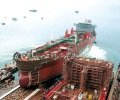
Driven by the Middle East war, new orders for very large crude carriers (VLCCs) worldwide in the first quarter surged to more than 21 times last year’s level for the same period. Early gains concentrated at Chinese shipyards with price competitiveness, but as Chinese docks were quickly filled and prices rose, orders have also been flowing to Korean yards. Hanwha Ocean has ridden this trend and won orders for 10 VLCCs so far this year. While Korea’s shipbuilders are using the tanker boom as a chance to secure profitability, their long-term strategic focus remains on high value-added, eco-friendly ships such as liquefied natural gas (LNG) carriers.
◇ First-quarter VLCC orders: 3 last year → 64 this year
According to Greek shipbroker Xclusiv on the 27th, global new orders for VLCCs in the first quarter totaled 64, surging from 3 in the same period last year. A VLCC is a class of vessel that can transport 2 million barrels of crude oil in one voyage, roughly equal to Korea’s daily consumption.
With traffic through the Strait of Hormuz restricted, some tankers were stranded, reducing available tonnage. As route uncertainty grew, short-term tanker charter rates jumped. Shipowners, citing improved operating profitability, moved to secure vessels, and new orders rose quickly. Coupled with replacement demand for aging tankers, tankers accounted for about 45% of all newbuilding orders in the first quarter.
Early orders concentrated at Chinese shipyards where prices were relatively low. Compared with LNG carriers, VLCCs have lower technical barriers to build, and their profitability lags high value-added ships, so Korean shipyards had not actively pursued these orders. Chinese private shipbuilder Hengli Heavy Industries is said to have won orders for more than 38 VLCCs in the first quarter alone. Across all Chinese yards, 399 ships totaling 12.39 million CGT were ordered in the first quarter, for a 70% share of global orders.
But after the war, VLCC charter rates and newbuilding prices rose together, changing the landscape. The newbuilding price for large tankers was $129.5 million in March, up 3.6% from a year earlier. As prices rose, Korean shipyards had more incentive to compete for orders. With construction slots at major Chinese yards largely filled through 2029 deliveries, shipowners also had little choice but to look to Korean yards to meet schedules. With conditions aligning on both the demand and supply sides, orders began to flow to Korean shipyards.
VLCCs bring welcome relief, but Korean shipbuilders’ center of gravity is LNG carriers
Hanwha Ocean has won orders for 10 VLCCs so far this year. That is 2.5 times more than the 4 ordered in the same period last year. Contract prices also rose from $129 million to $129.7 million per ship last year to $130 million to $130.5 million this year. Hanwha Ocean is securing profitability by boosting efficiency across design, procurement and production through a repeat design approach that reuses proven models. HD Korea Shipbuilding & Offshore Engineering and Samsung Heavy Industries have won orders for 7 and 4 crude carriers, respectively, so far this year.
Hanwha Ocean and other Korean shipbuilders plan to continue a high value-added, large-ship order strategy while selectively taking VLCCs and other tankers that have become more profitable in the short term. A Hanwha Ocean official said, “We plan to continue a selective order strategy focused on high value-added large ships while responding flexibly to market volatility.” As of March, Hanwha Ocean’s order backlog stood at 63 LNG carriers and 37 VLCCs, with LNG carriers nearly double.
LNG carriers require advanced technologies such as cargo containment systems and cryogenic equipment, and their prices are about twice those of VLCCs. As of last month, the newbuilding price for a 174K-class LNG carrier was $248.5 million, 92% higher than a large tanker ($129.5 million). In fact, LNG carrier orders at Korea’s big three shipbuilders are rising sharply this year. Hanwha Ocean has won orders for 4 LNG carriers this year, doubling from 2 in the same period last year. HD Korea Shipbuilding & Offshore Engineering has increased from 1 to 12, and Samsung Heavy Industries from 1 to 6. An industry official said, “While securing profitability from the tanker boom, we are pursuing a strategy to widen the technology gap in LNG carriers and eco-friendly ships that China finds hard to challenge.”
Source: ChosunBiz