Seadrill’s new rig deals of over $860 million lift...
2 hours ago

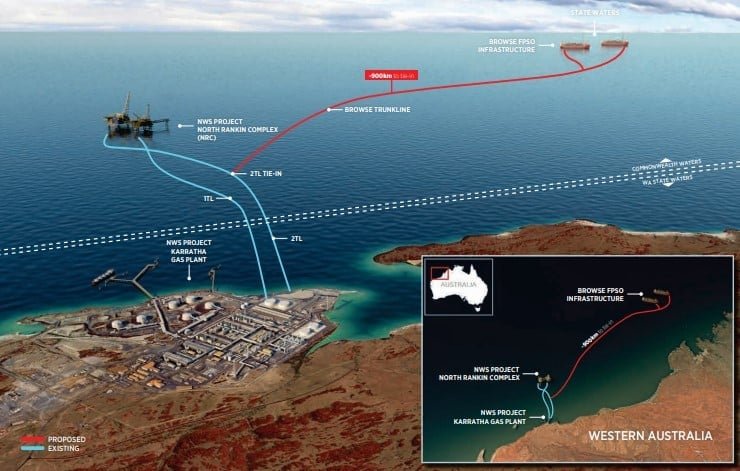
Australian energy giant Woodside has highlighted the findings of a new report, which indicates that the development of what is said to be Australia’s largest untapped conventional gas resource could bring a multibillion-dollar boost to the country’s economy, while fortifying its energy security.
After Woodside obtained environmental approval for the North West Shelf (NWS) project extension from the Western Australian government, restarting the federal environmental approvals process, the green light was perceived to be the key to advancing the firm’s $30 billion Browse gas project and extending the Karratha gas plant’s life to 2070. This project is currently in the concept definition phase, and key activities continue in support of progress towards front-end engineering and design (FEED) entry.
The Australian operator released an economic impact assessment by Deloitte Access Economics, which estimates the Browse to NWS project could contribute a long-term uplift of around A$147 billion ($102.9 billion) in gross state product for Western Australia, more than A$141 billion ($98.7 billion) in gross domestic product (GDP) nationally, and over A$56 billion ($39.2 billion) in taxes, including A$19.8 billion ($13.9 billion) in petroleum resource rent tax (PRRT).
The independent modelling shows the proposed Browse to North West Shelf project represents a significant opportunity to strengthen Australia’s energy security, support the energy transition, and deliver long-term economic benefits for Western Australia and the nation. The report also points to substantial employment and economy-wide benefits if the multibillion-dollar project proceeds to development.
Liz Westcott, Woodside’s Chief Executive Officer, emphasized: “Browse is Australia’s biggest undeveloped offshore gas resource and represents a major opportunity for the nation at a time when energy security matters more than ever.
“Independent modelling shows Browse has the potential to power homes and businesses, support thousands of Australian jobs and generate significant revenue for governments while also helping to manage the risks and costs of the energy transition.”
Woodside underlines that the Deloitte assessment finds Browse is not just an energy project, but a whole-of-economy investment, delivering benefits well beyond the oil and gas sector. The modelling estimates the project could deliver up to 4,760 direct and indirect full-time equivalent jobs across Australia at peak operations.
Given that around 80% of economic impacts are expected to flow to industries outside oil and gas, including construction, services, and public services, the findings indicate Australian communities, businesses, and public services are expected to benefit if the Browse to NWS project is developed.
Additionally, Deloitte Access Economics’ independent modelling points out that the project could ease pressure on Western Australia’s energy system as the state implements its energy transition plans, estimating that additional domestic gas from Browse could support a more stable and reliable energy system.
This is expected to be accomplished by generating electricity to keep the lights on in homes and businesses, backing up renewables, enabling a more orderly and lower-cost scale-up of renewable energy, supporting critical minerals processing and other energy-intensive industries needed for electrification.
Woodside underscores that Browse gas could also play a role in helping Australia’s trading partners in the Asia Pacific reduce their reliance on coal-fired power while also supporting energy security in the region. The project has a forecast production capacity of 11.4 million tonnes per annum of LNG, LPG and domestic gas, and a peak condensate production rate of 50,000 barrels per day.
The proposed Browse to NWS project would deliver natural gas from the Calliance, Torosa, and Brecknock fields to the existing Karratha gas plant via an approximately 900-kilometer pipeline, connected to two floating production, storage, and offloading (FPSO) units.
As elaborated by Woodside, a carbon capture and storage (CCS) solution has been incorporated into the project design and is expected to enable a reduction of 53 million tonnes (mt) CO2e of greenhouse gas (GHG) emissions as compared to the project’s 2019 Scope 1 emissions estimate.

Take the spotlight and anchor your brand in the heart of the offshore world!
Join us for a bigger impact and amplify your presence at the core hub of the offshore energy community!