Baltic Dry Index Rebounds | Hellenic Shipping News...
5 hours ago

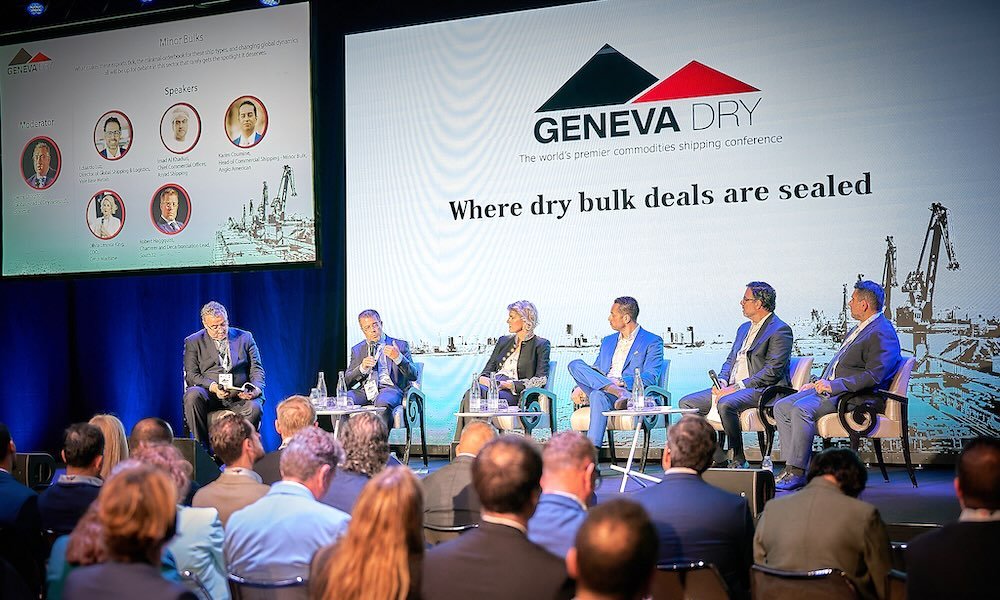
The minor bulks panel at last month’s Geneva Dry 2026 turned into a broader debate on how shifting commodity flows, geopolitical disruption and tightening vessel supply are reshaping the geared dry bulk market.
The session — the third discussion of day two — focused on what is driving global minor bulk exports, the relatively modest orderbook for geared tonnage, and how owners, charterers and commodity producers are adapting fleet deployment strategies to cope with regional volatility and seasonal swings.
Moderated by Derek Langston, the panel brought together executives from South32, Cetus Maritime, Anglo American, Vale Base Metals and Asyad Shipping.
The discussion highlighted how minor bulk trades are becoming increasingly tied to energy transition commodities, including copper, aluminium inputs, nickel feedstocks and fertiliser products, while trade routes are simultaneously being reshaped by Middle East disruption, changing Chinese demand patterns and supply security concerns.
Robert Haggquist from South32 said tariff tensions and geopolitical uncertainty had already changed trading behaviour over the past year, particularly through inventory building and strategic stockpiling.
“We did see traders building up inventories in anticipation of all these tariffs and measures,” he said. “That created additional volatility in the market, created inefficiencies and also created a disconnect between shipments and underlying consumption.”
He added that some governments were now building strategic inventories of key minor bulk commodities as a hedge against future disruption.
Several panellists pointed to copper as one of the clearest long-term demand stories for geared bulkers.
Head of commercial shipping – minor bulk at Anglo American, Karim Coumine, said demand growth tied to electrification, EVs and industrial development continued to underpin copper concentrate flows from South America into Asia.
“There just isn’t that great investment or amount of new investment in copper supply at the moment,” he said. “It takes a lot of money to invest in a copper mine. It takes a lot of time to bring it online.”
Vale Base Metals’ Eduardo Luz said the industry still faced a substantial future supply gap despite strong growth plans.
“We see a need of 10m tonnes of refined copper in the market,” he said. “Projects take a lot of time to come online.”
Vale expects its Brazilian copper shipments to double to 2m tonnes by 2035 as new projects ramp up.
The panel also examined how sulphur shortages and fertiliser trade disruption linked to tensions in the Middle East were feeding through into shipping demand and commodity pricing.
Luz said sulphur prices had surged above $800 per tonne, sharply increasing nickel processing costs in Indonesia.
“Sulphur is becoming a hot topic for base metals producers,” he said.
Asyad Shipping’s Imad Al Khaduri described Oman’s growing role as a logistics and storage hub as cargoes increasingly bypassed disrupted Gulf routes.
“We see Oman by default being a gateway for a lot of cargoes,” he said. “Companies want to make sure they keep running. It’s not about profitability, but making sure plants stay online.”
One of the central debates during the session focused on fleet composition and whether geared bulkers remain adequately supplied for increasingly fragmented trade patterns.
Olivia Lennox-King, chief of operations at Cetus Maritime, argued that flexibility was becoming more important than scale alone.
“What you want in a geared vessel is extreme versatility,” she said. “You can pivot when the market changes.”
She said larger geared designs had steadily gained market share over the past decade, with ultramaxes increasingly viewed as the “ultimate workhorse” of the geared sector, but stressed there were still hard limits imposed by ports and cargo characteristics.
“A lot of cargoes still need geared vessels,” she said. “I do not think this is a slide upwards to every vessel being a capesize.”
Lennox-King also pushed back on the idea that the geared fleet was severely underbuilt, noting that around 200 handysize vessels were due for delivery this year, while scrapping activity remained extremely limited despite the ageing fleet profile.
“We haven’t seen the kick-in of decarbonisation yet,” she said. “We have an older fleet, that’s true, but they’re still working.”
Still, panellists agreed that short-term vessel availability was tightening due to a combination of drydockings, longer voyages, rerouting and ships trapped in disrupted regions.
Lennox-King estimated that roughly six months of newbuilding supply was effectively tied up in the Middle East, while vessels slowing down or taking longer routes were removing latent supply from the market.
“That is also driving the current market as much as increases in commodity demand,” she said.
Coumine said supply-side disruptions were currently playing a bigger role than commodity demand growth in shaping freight markets.
“There’s about 1% of the dry bulk fleet stuck in the Persian Gulf right now,” he said. “The geopolitics, the blockages — it’s very much a supply story.”
The session also explored whether transhipment and alternative logistics corridors could ease port bottlenecks and draft restrictions that continue to limit vessel upsizing in several trades. Both Vale and Anglo American executives said transhipment was already part of daily operations for copper concentrate trades into northern Europe, although higher cargo values and operational complexity limited how far the model could expand.
Port constraints were repeatedly cited as one of the main barriers preventing further migration towards larger geared vessels.
“The ports aren’t getting that developed actually,” Coumine said. “There will be a natural limit.”
Haggquist added that Australian draft limitations were already complicating chartering strategies for newer supramaxes and ultramaxes.
“You still want it below 10 years, but there aren’t that many of them anymore,” he said.
The debate ended with panellists warning that higher bunker prices, longer routes and geopolitical disruption were becoming embedded features of the market rather than temporary shocks.
“With high bunker costs, this is the new norm,” Al Khaduri said.