We have made the garbage move faster
2 hours ago

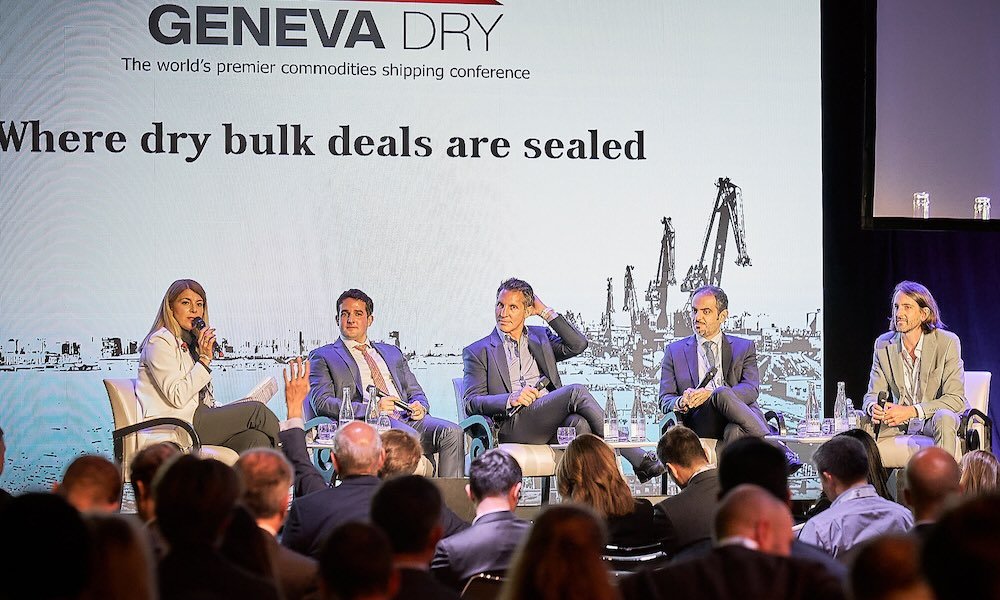
The agri-commodities session at Geneva Dry last month, moderated by Maryana Yarmolenko Stober, the president of WISTA Switzerland, delivered a grounded assessment of how the Middle East war and Hormuz closure are reshaping global food and fertiliser supply chains – with speakers united on one point: trade flows are not collapsing, but they are being radically re-engineered at considerable cost.
Filipe Gonzaga, managing director of Bryce, opened with a trader’s-eye view of shifting origins. His business, heavily focused on Ukrainian grain into North African markets, has had to pivot sharply. “We see more and more demand out of South America, especially for future crops, and also unusual flows for US cargoes out to the Mediterranean markets,” he said. Routes previously considered marginal are now becoming primary arteries.
Rob Aarvold, CEO of Singapore-based operator Legasea, said that since the Hormuz crisis had begun the bunker market had been perhaps the most acute pressure point for dry bulk operators. “MGO has traded up to 300 or 400% of where I was trading two months ago in a place like Brazil,” Aarvold said. The Panama Canal has added further complexity – slot bookings now stretch two to three months forward, making it nearly impossible to provide freight price certainty to traders working on three or four-week horizons. “The market has been almost unhedgeable,” he said. “We’ve seen a complete dislocation between your swap and your physical delivery price.”
Abdullah Bin Eid, commercial vice president of Bahri Dry Bulk, offered the most philosophical description of the crisis. “History showed that grain flows don’t stop. They reroute. What we are seeing today is not a collapse of trade, but a re-engineering of it.”
Saudi Arabia, he said, was actively moving beyond its traditional role as a commodity importer to manage sourcing, shipping and storage strategically. “The system adapts, routes change, but the flows continue.” On force majeure, he noted some cargo owners and ship operators had invoked it – primarily in oil and gas and for vessels unable to enter the Arabian Gulf – but the broader picture was one of adaptation rather than contractual breakdown.
Pierre Morel, VP of market intelligence at AXSMarine, provided the data architecture underlying these market shifts. The most striking finding was the fleet-wide speed reduction triggered by elevated bunker costs. The global dry bulk fleet had slowed by approximately half a knot since the conflict began – from around 10 knots to 9.5 knots. The supply implications are substantial. “If you decrease just by half a knot on panamaxes – 19,000 voyages averaging 40 days at sea – you add two days per voyage, removing 38,000 vessel-days from the market, equivalent to roughly 104 vessels,” Morel explained. “You are netting out half of the panamax orderbook coming this year. And it’s happening now.”
On the downstream commodity impact, Morel flagged a concrete example already playing out: a major Moroccan fertiliser producer – dependent on Arabian Gulf and Russian sulfur, the latter now subject to an export ban – had begun cutting production by 30% in the second quarter. “It’s happening quickly,” he said.
Gonzaga captured the trader’s underlying logic, telling delegates: ”Trading is the absorber of volatility. The market will find a way and will factor in the risk. Is the price worth the risk? Yes or no? It’s all a matter of pricing at the end of the day.”
Aarvold closed with a summary of where the industry finds itself. “It feels like we’ve had an aggregation of every black swan event. As an industry we’ve become more adaptable. But the longer this goes on, the more real it’s getting that the risks are elevating.”