FMC hits Maersk with $1.9m penalty over detention ...
2 hours ago

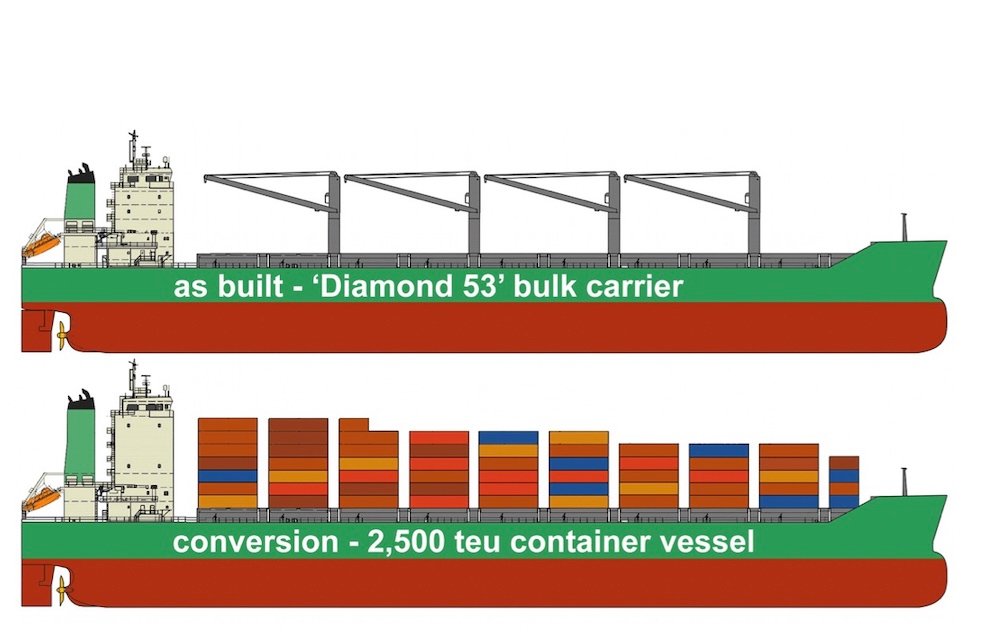
The sustained strength of the container market is prompting shipowners to reach beyond the orderbook for solutions, with plans now underway to convert at least two supramax bulk carriers into cellular container vessels of around 2,500 teu, according to Alphaliner.
The vessels earmarked for conversion are Diamond 53 type open-hatch supramaxes, primarily built between 2005 and 2011 by CSSC Chengxi Shipyard at Jiangyin, China. Their double-hulled, open-hatch design makes them among the more practical candidates for conversion, Alphaliner said, requiring relatively straightforward modifications compared with conventional bulk carriers.
The main changes involve removing the ships’ four centreline cranes and raising the wheelhouse by approximately two decks to allow container stacks of seven tiers on deck. Vessel dimensions remain unchanged at 190 m in length and 32.29 m in breadth, accommodating 13 rows of containers. Work on the first vessel is expected to begin in late May or early June, with the converted ship available for charter in China roughly three months after entering the shipyard.
The Diamond 53’s top speed of just over 15 knots is slow by container vessel standards, but Alphaliner said this need not be a barrier. Given major carriers’ recent appetite for low-specification tonnage – slow ships with limited reefer intake – converted vessels of this type could attract lucrative charters on regional, domestic or feeder services, where speed is less critical than availability.
Alphaliner noted that open-hatch bulk carriers are the only realistic candidates for this kind of conversion. Conventional bulkers would require far more extensive structural surgery. Unlike true container ships, open-hatch carriers already feature double hulls and holds designed with containers or breakbulk in mind, though they lack cell guides and lashing bridges. A targeted conversion adding cell guides inside holds, raising the wheelhouse and fitting basic lashing bridges could address most of the functional gap at manageable cost.
The conversions are the latest sign of a container market still operating with limited slack. With most vessels sold out and charter rates remaining elevated, the incentive to bring non-standard capacity to market is rising.
The blurring of lines between bulk and container shipping is not a new phenomenon. Splash reported in January that COSCO Shipping Bulk had ordered a series of container-capable newcastlemax bulk carriers – three 210,000 dwt vessels from CSSC Qingdao Beihai Shipbuilding, featuring methanol- and ammonia-ready designs with the ability to carry containers alongside bulk and general cargo.
The flexibility strategy has clear precedent from the pandemic era, when boxes migrated onto bulkers and Star Bulk became one of the first cape owners to secure class approval for container carriage.