FMC collects civil penalty payment of $1.9m from s...
2 hours ago

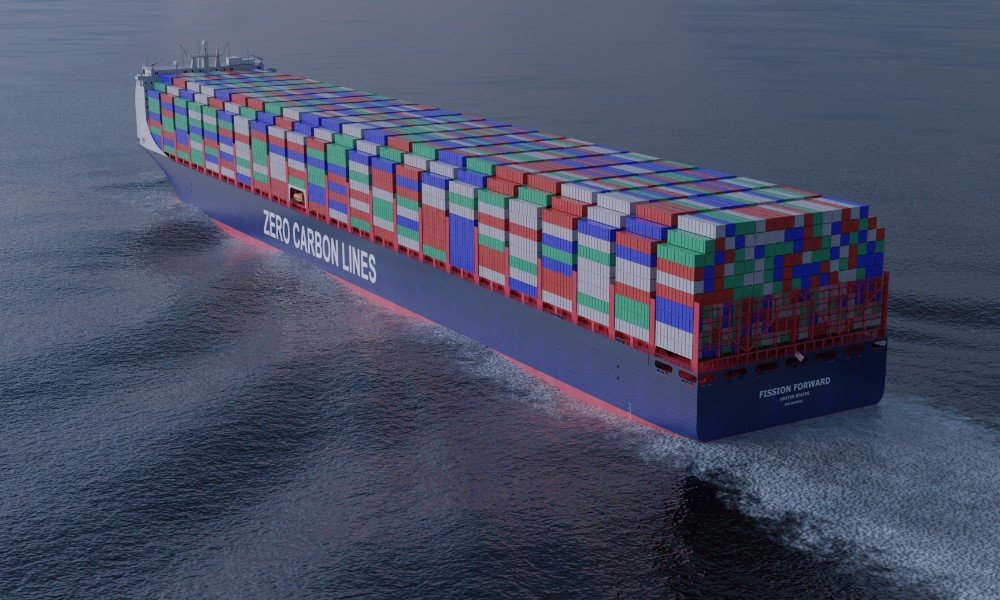
Andrew Craig-Bennett makes the case for nuclear-powered containerships.
It looks as if the amateur naval theorists’ talk about “choke points” has been listened to, by all the wrong people. It may well be that most ships sailing between Asia and Europe will be taking the longer way round, and not using the modern, much improved, Egyptian version of Monsieur de Lesseps’ canal, for some time to come.
Every crisis is an opportunity. I see an opportunity. The closing of the Suez Canal in 1967 was an opportunity for shipowners in general and tanker owners in particular to build bigger, more fuel-efficient per ton of cargo, ships. Shipowning never looked back.
If containerships are going to have to go the long way round, the economic case for a string of really big, really fast, nuclear-powered containerships becomes quite persuasive.
Let us say a dozen 25,000 teu ships making at least 25 knots, ideally even more, with a really good sea margin, between a handful of hub ports. In engineering terms, this is quite possible with the equipment that we have now, and the ports can handle ships of this size.
As we all know, the constraints on civil nuclear at sea are not technical but financial and quasi- political.
I don’t think insurance is going to be a speed bump on the road to progress, here. Insurance has a wonderful way of becoming available, and most of the work on the insurance of nuclear merchant ships has already been done.
We are looking at big, very fast, containerships, calling at a handful of ports. This, and the economic value of the trade, should make it possible for half a dozen container ports to agree to accept nuclear ships. We also need a drydock, for the usual reasons, and we will need a nuclear refuelling facility – which need not be in the same place as the drydock – because civil nuclear plants cannot use the more enriched stuff that fuelled for life warship reactors use.
That means that refuelling a merchant nuclear ship will take a bit longer than the usual dry docking, but it can be done.
That leaves the financing of this very big project, and if we accept that a nuclear ship costs about twice what a conventional ship costs in first cost, but rather less over her life, because she isn’t constantly buying fuel, we come up with a package that looks ideal for lease finance.
Let’s take this further. The long-haul containerlines are organised into consortia, and they exchange slots. One of the big consortia could go nuclear, but that’s not the only possibility.
Someone outside the containerline business – and by that I mean both the lines themselves and the NVOCCs – either another shipowner or, for the sake of argument, someone completely outside the business, such as a government, could own a string of big fast nuclear boxboats and lease space in them to the lines on a long-term basis.
Does that start to look like a proper financeable package? I think it does. Rather along the line of our industry’s other super big ticket activity – strings of LNG carriers with liquefaction and re-gasification trains.
I remember a useful rule about LNG projects, which is that you need three utilities at the downstream end to make a project viable.
Container consortia as such may not be bankable, because they sometimes split and re-form, but containerlines obviously are.
Would it be possible to get three of the main containerlines into the same room and persuade them to each take a 25-year lease on one-third of the slots? I think it would be possible – after all, they are in the same room for Box Club purposes from time to time.
I think a big containerline may not be so very different, in financing terms, from a utility.
The actual speed bump on the road to progress is a different one – it is the global shortage of reactor officers. This is a more serious problem – we are going to need twenty of them! The rest of the crew will also need film star wages (this was a problem with the USNS Savannah, if I recall correctly – the nuclear officers were on a different pay scale to the marine officers) but they can get them, because these ships are going to make lots of money.I have already argued that nuclear ships will bring in totally different standards of remuneration and respect for merchant seafarers.
It takes about 10 years to educate (not “train”, educate) a reactor officer, and their career path tends to involve submarines and power stations – why not add a third option?
This makes sense in ordinary commercial terms without any special arrangements to encourage greenery.
Time to get started?