Dry Bulk Shipping: Capesize Market Showing Strengh...
3 hours ago

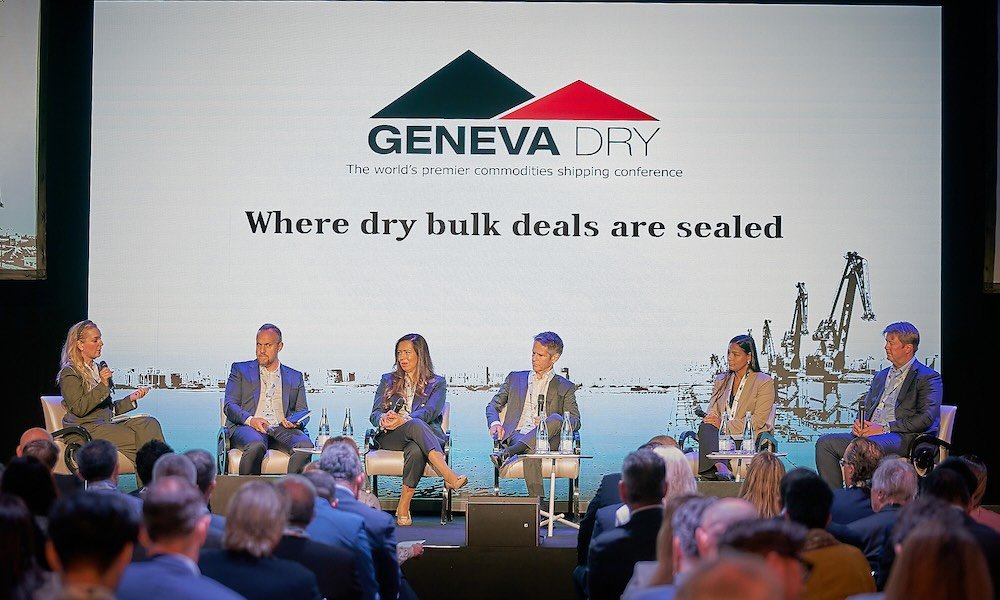
The dry bulk sector’s decarbonisation debate has moved decisively beyond whether shipping will reach net zero and is now centred on how the industry can make the transition work commercially in an increasingly uncertain world.
That was the clear message from the Dry Decarbonisation panel, the second session on day two of last month’s Geneva Dry conference, where owners, charterers, analysts and operators discussed how the pathway toward lower emissions has evolved since the event’s inaugural edition two years ago.
Moderated by World Economic Forum lead industry and climate nexus Mette Asmussen, the discussion focused on the practical realities of the transition, from fuel choices and efficiency upgrades to carbon pricing, regulation and who ultimately pays for cleaner shipping.
“There are two things that are important for decarbonisation,” Asmussen said at the outset. “Constant care” and “agility”.
Eman Abdalla, founder and chief executive of Seathrew Marine, said the industry’s mindset had shifted significantly since the previous Geneva Dry gathering.
“Two years ago we were discussing if decarbonisation is something we all believe in or not,” she said. “Today the question is not necessarily if, instead it’s how and by when.”
Abdalla argued that despite geopolitical instability and regulatory uncertainty, shipping had still made progress through pilot projects, operational efficiency gains, energy-saving devices and dual-fuel newbuildings.
“Now is the time for scalability,” she said. “The focus should be on how we are going to make investable decisions going forward.”
Much of the debate centred on the economic reality facing dry bulk shipping, where margins remain thinner than in tanker or container markets.
Alastair Stevenson, head of digital analysis at SSY, said carbon costs have a proportionally bigger impact on bulk shipping economics.
“In the dry market especially, it’s over time quite a low-margin business,” he said, adding that EU emissions costs can account for 1% to 2% of cargo value in bulk trades, compared with fractions of a percent in other shipping sectors.
Stevenson argued that the real burden of decarbonisation goes beyond fuel and emissions costs, extending into legal, compliance and contractual complexity.
“The decarbonisation cost is much more than the relatively simple monetary cost,” he said.
Vale’s global head of chartering Michelle Gonzalez detailed how the Brazilian mining giant has spent years pushing shipping efficiency measures through partnerships with owners and technology suppliers.
The company has invested heavily in scope 3 emissions initiatives and aims to reduce shipping emissions by 15% by 2035.
Gonzalez said Vale has spent more than 15 years testing technologies ranging from advanced hull coatings and propeller upgrades to wind propulsion systems.
“I dare to say that Vale controls the biggest fleet at this moment of vessels with wind propulsion,” she said.
While some trials delivered mixed results, Gonzalez stressed that failure was part of the learning process.
“Every single pilot is better than the previous one,” she said. “Innovation is so fast.”
Several speakers pointed to wind-assisted propulsion as one of the most promising short-term solutions for bulk shipping.
Klaveness Combination Carriers chief executive Engebret Dahm said wind-assist systems currently offered one of the best combinations of lower capital costs and performance gains.
“We test it out, we trial it, and if it works, we implement it and scale it on our whole fleet,” he said.
Dahm also highlighted operational measures such as AI-based weather routing and digital optimisation systems as relatively low-cost ways to cut emissions immediately.
Louis Dreyfus Company shipping decarbonisation lead Fabian Kowatsch repeatedly stressed the importance of collaboration between owners and charterers.
“It is very important to build projects between owners and charterers,” he said.
The agricultural trading giant has worked with owners on coatings, engine optimisation and fuel-efficiency projects, growing from a single decarbonisation initiative in 2022 to 14 collaborative projects last year.
“We can still find a lot of win-wins in this industry if we listen to each other,” Kowatsch said.
The panel repeatedly returned to the idea that fuel flexibility and optionality are becoming increasingly important as uncertainty clouds the regulatory landscape.
Vale recently made headlines with its ethanol-fuel plans, while Louis Dreyfus has methanol dual-fuel vessels on order.
Gonzalez described ethanol and methanol as practical early-stage solutions because they are already relatively mature and commercially accessible.
“We like quick wins,” she said.
Still, owners remained cautious about committing to expensive fuel transitions without regulatory clarity or customer support.
“We do not do huge investments in our ships to make them ready to burn new type of fuels unless we have predictable and effective regulations,” Dahm said.
He added that owners currently lacked both firm regulations and customers willing to fully pay for greener ships.
Abdalla argued that uncertainty itself has now become permanent.
“Uncertainty is structural,” she said. “You need to embed uncertainty in your strategy.”
That means balancing immediate efficiency upgrades with long-term flexibility on future fuels and technologies.
The thorny question of who ultimately funds decarbonisation also resurfaced throughout the session.
“As an industry, we are here to serve other industrial players,” Abdalla said. “Unless they are willing to pay for decarbonisation one way or the other, we’re not going to be able to invest and fund it ourselves.”
Dahm countered that the overall cost impact on end consumers remains relatively small.
“It’s basically nothing,” he said, referring to the impact of shipping decarbonisation on the final cost of goods such as cars or grain.
Audience questions brought further discussion on wind propulsion technologies, charter-party reform and LNG.
On LNG, Dahm argued the fuel still offers meaningful emissions reductions despite criticism from some parts of the industry.
“It actually delivers quite large emission reductions,” he said.
Stevenson warned, however, that shipping may eventually compete with other industries for access to low-carbon fuels.
“The shipping sector always finds a way and always finds the lowest-cost way,” he said.
As the session closed, panelists agreed that the industry now needs faster implementation rather than more debate.
“Start slow, start with small investment, but start,” Gonzalez said. “Decarbonisation is there. There is no way back.”