Clarksons builds Americas footprint with Serpac de...
2 hours ago

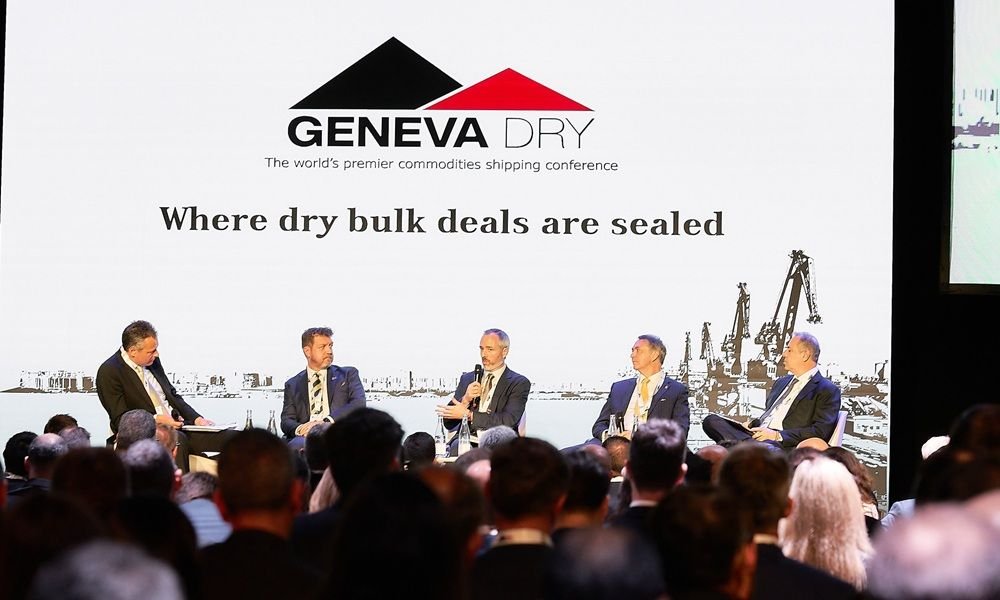
The third edition of Geneva Dry opened in characteristically candid style, with the commodities shipping outlook panel setting the scene for two days of debate by tackling the markets, the two-tier fleet, the bunker crisis, and the faltering green transition – and pulling no punches on any of them.
Moderator Sam Chambers opened with a show of hands that revealed a divided room. While the panel was unanimous that this is the most complex period any of them had experienced in shipping, only around half the audience agreed.
Fewer still raised their hands when asked whether dry bulk markets would be better at next year’s Geneva Dry.
Alexis Ellender, lead dry bulk analyst at Kpler, opened with the numbers, and they were largely encouraging.
Seaborne dry bulk trade grew just over 2% in the first four months of 2026 to approximately 1.7bn tonnes. TC rate averages for panamaxes, supramaxes and handysizes are up 56%, 41% and 34% year-on-year respectively. “Dry bulk trade is growing. It’s a good time for us to be discussing it,” Ellender said.
But the picture is complicated. The closure of the Strait of Hormuz is cascading through commodity supply chains in ways that are only beginning to be felt. Fertiliser exports from the Middle East Gulf – some 36m tonnes annually – have been disrupted, affecting planting decisions as far away as the US corn belt. Sulphur, critical not just as a fertiliser but for processing nickel and copper ore, is now being sourced from west coast Canada instead of the Gulf, creating new Pacific supramax demand while raising questions about Indonesian nickel ore throughput.
Coal is another moving part. Indonesia had been cutting production to support prices, but that calculus has shifted with gas-to-coal switching accelerating across East and Southeast Asia as LNG supplies tighten. “Are we looking at Colombia? Are we looking at Russia to supply the coal now needed?” Ellender asked.
On China, Peter Lye, executive head of marketing for shipping and safety at miner Anglo American, was sanguine. “We consistently write it off year on year, and I think what we’ve seen this year is not that at all. Demand for the products that we produce has been consistent and strong.” Cape rates pushing $40,000 per day at the time of the panel underlined his point.
Ellender was more measured on the medium term. China’s economy needs to transition from investment-led to consumption-led growth, a painful process that keeps being deferred. “It’s almost an article of faith – how long can this game keep going?”
On India, Lye said: “It’s just different. It seems to be quite targeted and quite nuanced to particular trades,” he said, cautioning against the recurring temptation to call India the next China.
John Xylas, CEO of Ariston Navigation and chairman of INTERCARGO, delivered one of the panel’s most substantive contributions on the bifurcation of the global dry bulk fleet. A thickening compliance stack – EU ETS, FuelEU Maritime, CII, EEXI, tightening port state control and charterer vetting – is creating a growing divide between well-managed and less well-managed tonnage.
Crucially, Xylas argued, the dividing line is not vessel age or size but quality of management.
“The agility of small to medium enterprises is not a weakness, it is definitely an asset that we should preserve,” he said.
Lye echoed the point from the charterer’s seat. “We don’t apologise for expecting high standards. We expect it of ourselves and we certainly expect it of our partners.” Anglo American, he stressed, does not intend to be a passive charterer – it wants to actively shape the market toward higher standards.
The bunker situation drew animated discussion. Xylas was direct: “It’s not so much the price. It’s the availability. Trying to source the bunkers that you need or the right type of bunkers.”
The panel noted that the Singapore price spike at the onset of the Hormuz crisis was initially sentiment-driven rather than reflecting immediate physical scarcity – but Ellender warned the fundamentals are now catching up.
Refineries maximising distillate production will squeeze fuel oil supply to shipping, while countries switching from gas to fuel oil for power generation are adding demand. “The only way the market is going to balance is demand destruction,” he said, adding that bunker prices are unlikely to return to pre-war levels soon.
Alex Gregg-Smith, president of marine and offshore at Bureau Veritas and incoming IACS chair, gave the room a frank assessment of proceedings at MEPC 84 in London. “They’re trying to avoid the difficult decisions and the difficult ones are going to be coming at the plenary session towards the end of the week,” he said. “I think what might happen is there could be another postponement.”
Xylas, speaking in a personal capacity, delivered the panel’s sharpest critique of current decarbonisation policy, questioning the scientific credibility of hydrogen, ammonia and green methanol as realistic near-term options at the scale required by shipping. “Unless our goal is to tax the industry and not to clean the environment, we need to be honest about that,” he said.
Gregg-Smith urged pragmatism and collaboration, pointing to China’s renewable energy investment and the concept of green corridors and hubs as potential building blocks. “We need to be ambitious, but we need to be pragmatic. Otherwise, there could be obstacles put in the spokes of the wheel and this could kick down the can or cancel completely.”
The session closed with Xylas offering a historical perspective that landed with the room: a modern capesize carries 200,000 tonnes at 10 knots on 30 tonnes of fuel per day. A Liberty ship in the 1950s carried 10,000 tonnes on the same consumption. “A 20-fold improvement without any regulation, simply because it is in the nature of the business to keep improving.”