Diana takes hostile route in push for Genco
2 hours ago

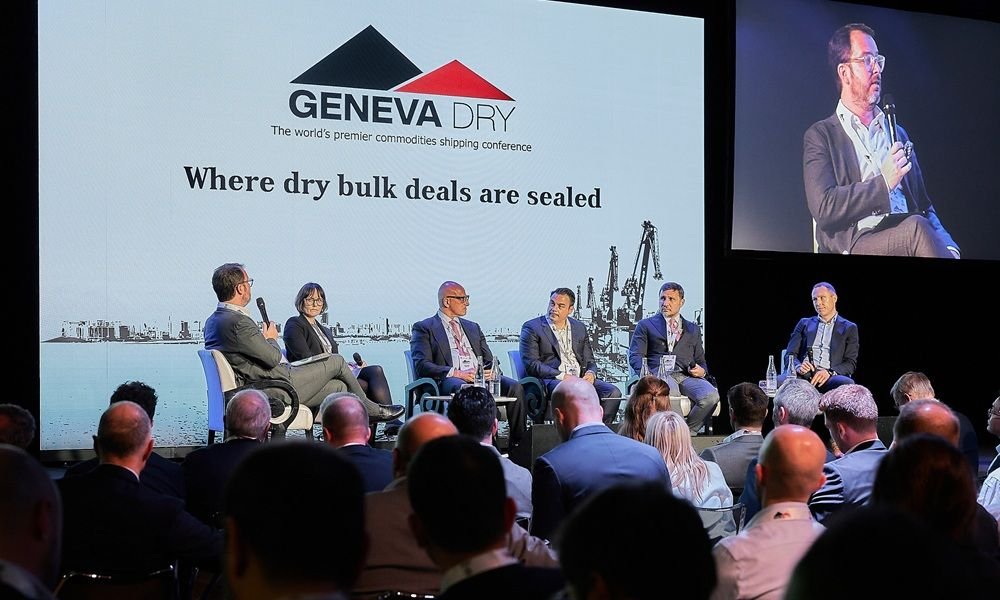
The flock of black swans has landed – and the risk management models that shipping built its strategies around are no longer fit for purpose. That was the consensus from Geneva Dry’s Risk Management in Dry Bulk panel last week, which brought together shipowners, operators, energy traders and market clearers for one of the conference’s most candid sessions.
Moderator Jason Martinet of Triton Bulk opened with a show of hands, revealing that roughly a third of the room was sitting on live freight exposure – time charters, cargo books, ship equity or bunker positions. He then rattled off the crises that have reshaped risk thinking since 2008: Brumadinho, covid, Panama Canal drought restrictions, Houthi attacks on Suez traffic, USTR measures, and now the closure of the Strait of Hormuz. “What used to be black swans are really now a flock of swans,” he said. “A pattern that happens quite often.”
Torbjørn Gjervik, CEO of Western Bulk, was direct about how his company has responded. “We have to make a choice – do we want to stay in a market? Do we want to stay in a trade? Or do we opt not to participate?”
Western Bulk has deliberately reduced its operated fleet from around 140-150 vessels to 110-115. “The volume is down, but I would say the margin per trade is up. More cautious, a bit more selective, basically trying to find where we think the risk-reward is good enough to participate.”
Vincenzo Romeo, CEO of Nova Marine Carriers, described how the company had built a natural hedge by evolving from pure shipowning into operating. “The more it grows our operating arm, the more ships we can buy as owners,” he said.
With a vessel currently stuck on the wrong side of Hormuz, Romeo credited the company’s diversification across vessel sizes – from 4,500 dwt coasters to kamsarmaxes – with providing resilience.
Costas Delaportas, CEO of Drydel Shipping, offered a similar account, describing a vessel trapped in the Persian Gulf for two months.
Beyond crew welfare – which he described as a daily priority – Delaportas said Drydel had given its charterer the flexibility to use the stranded vessel as floating storage. “We gave them this flexibility, which is very important during these difficult times.”
He also made an unsolicited call for the IMO to mandate slow steaming across the global fleet given the bunker shortage. “Imagine how much fuel we can save if all owners in this world go slow steaming during this difficult period.”
Gus Majed, group CEO of Paratus, brought the energy trading perspective and delivered some of the session’s surprising analysis. His firm calculates that by year-end, global oil stocks will have drawn down by approximately 1.2bn barrels, with the physical procurement crunch only beginning to bite in the next two months. “It is not so much what is the price – it is the availability,” he warned.
On risk models, Majed was unsparing. “Not only do they no longer work – they are completely and fundamentally obsolete.” The old assumption of log-normal distributions and mean reversion has been overtaken by a world of fat tails and correlated extremes. “All these risks are no longer independent. They are cross-correlated and there’s a sequence between them – a knock-on effect.”
When asked whether traders are simply too poorly capitalised to hold positions long enough to be proved right, Majed was unequivocal. “100%. Up to the point where you are a fundamental expert and you know your market. The very best traders in the world got it completely wrong – but for about the first week. Then they were able to turn it around very quickly because they understood what was happening on the physical and they had the liquidity.”
Karen Taylor, head of industrial commodities at ADM Investor Services, described how clearers are responding to the new environment. “We accept that the models do break – and right now they break more frequently and more fundamentally than previously.” Her team stress-tests client positions not just against historical scenarios but against hypothetical extremes, applying increasingly conservative margining. “It’s about being resilient to manage those gaps that we see more and more frequently.”
On the question of whether the FFA market has improved risk management or simply given participants more sophisticated ways to lose money, Taylor was measured. “Liquidity in the market can only be good for it. If you can trade on a Friday afternoon now, whereas 10 or 15 years ago you’d struggle to get an FFA done on a Friday afternoon – that’s progress.”
Gjervik and Majed agreed that the arrival of algorithmic macro traders has added volatility and dislocation, but also opportunity for those with the data capability to identify and exploit it. “It requires totally different skill sets,” Gjervik noted. “You might need people from a totally different background compared to your usual chartering manager.”
On vessel investment, Delaportas said the old question of scrap value has been superseded. “Now I think in order to have a competitive dry bulk business, you need to focus on how efficient the vessel is, the speed, the consumption – efficient, efficient, efficient is the word to go forward.” Drydel has invested in more than 25 newbuildings at Japanese yards over the past decade. “All the charterers want to fix efficient vessels and I’m very glad we have done it.”
Romeo pointed to a broader principle for weathering cycles: keep the money in the company, not in the shareholders’ pockets. “The best deals are made when the market is low and you have to be ready to buy. Whenever you have good years, it’s better to have a rich company and a good balance sheet, rather than a rich shareholder and a poor company.” It is, he said, a family philosophy that Nova has lived by for 45 years.
The session closed with Martinet summarising a theme that ran through every contribution: in a world where exceptional events are now routine, the competitive edge belongs to those with the deepest pockets, the most diversified portfolios and the discipline to stay in the game when everyone else is being forced out. “You’re never really wrong,” he said. “You just don’t have deep enough pockets to weather until you’re right.”