Taiwanese bulker banned from Australia over unpaid...
2 hours ago

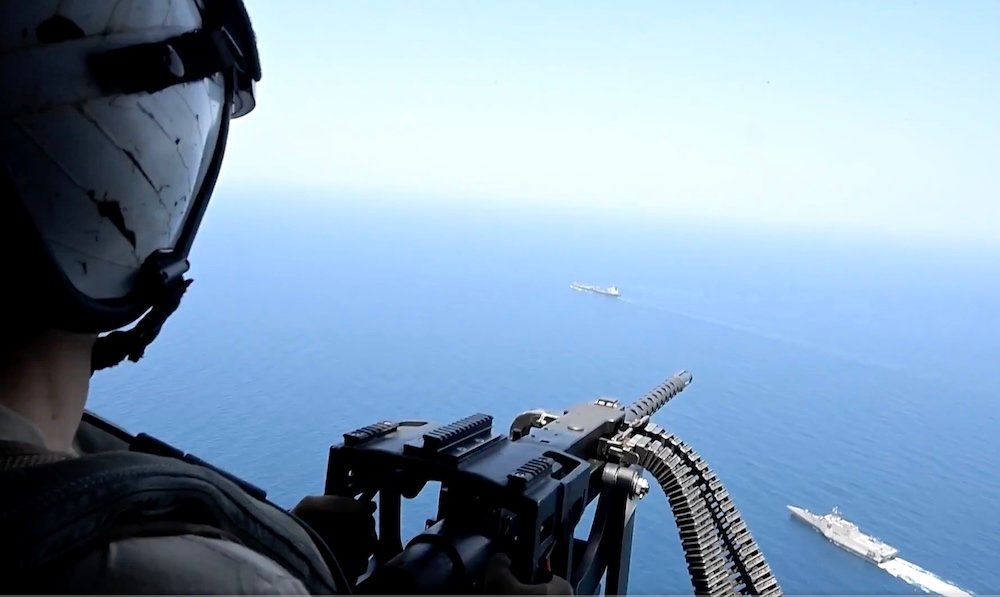
A US Navy F/A-18 Super Hornet launched from USS Abraham Lincoln has disabled the Iranian-flagged VLCC Hasna in the Gulf of Oman after the vessel allegedly attempted to breach the American naval blockade of Iran’s ports.
US Central Command said the aircraft fired its 20 mm cannon at the ship’s rudder after the crew of the 300,000 dwt tanker – built in 2003 and already on the US OFAC sanctions list since 2018 for its links to the National Iranian Tanker Company – failed to comply with repeated warnings. “The US blockade against ships attempting to enter or depart Iranian ports remains in full effect,” CENTCOM said. “Forces continue to act deliberately and professionally to ensure compliance.”
The attack on the Hasna is the latest in a sustained wave of vessel strikes that has turned the Strait of Hormuz and surrounding waters into one of the world’s most dangerous maritime zones. A CMA CGM containership was struck by missiles on May 5, causing crew injuries and vessel damage. An ADNOC-affiliated tanker was hit by drones on May 3. A bulk carrier was attacked by Iranian fast craft the same day. The brand new HMM Namu general cargo vessel suffered an explosion at anchor off the UAE on May 4.
Compounding the threat picture, Iran has issued fresh navigation guidelines claiming control over a widened section of the strait – a move that has alarmed regional shipping interests because the designated zone, as shown on maps circulated by the Islamic Revolutionary Guard Corps, appears to extend into waters surrounding three UAE ports: Fujairah, Khorfakkan and Umm Al Quwain.
The deteriorating situation throws into sharp relief the rapid collapse of Project Freedom, the Trump administration’s operation to escort stranded commercial vessels out of the Persian Gulf. The operation was wound down within just 36 hours of its launch – not, as initially suggested by the White House, primarily because of diplomatic progress with Iran, but because Saudi Arabia withdrew permission for US military aircraft to operate from Prince Sultan Airbase or transit Saudi airspace in support of the mission.
With the military option now effectively suspended pending Gulf ally realignment, a negotiated settlement has become the primary route to reopening the waterway. Iran was expected to deliver its response on Thursday to a US peace framework covering nuclear enrichment, sanctions relief and the restoration of free Hormuz transit.
For the roughly 1,000 commercial vessels and 20,000 seafarers still trapped in the Gulf, the diplomatic timeline offers cold comfort. Jakob Larsen, BIMCO’s chief safety and security officer, said the abrupt end to Project Freedom had created fresh difficulties for shipowners trying to plan their way out. “The suspension of Project Freedom shortly after its launch is a surprise. Changes announced at short notice or changes that are surprising, such as the sudden suspension of Project Freedom, are a challenge for shipowners attempting to assess the risks and planning for leaving the Persian Gulf,” he said.