Geneva Dry Dialogues: Klaveness Digital
1 hour ago

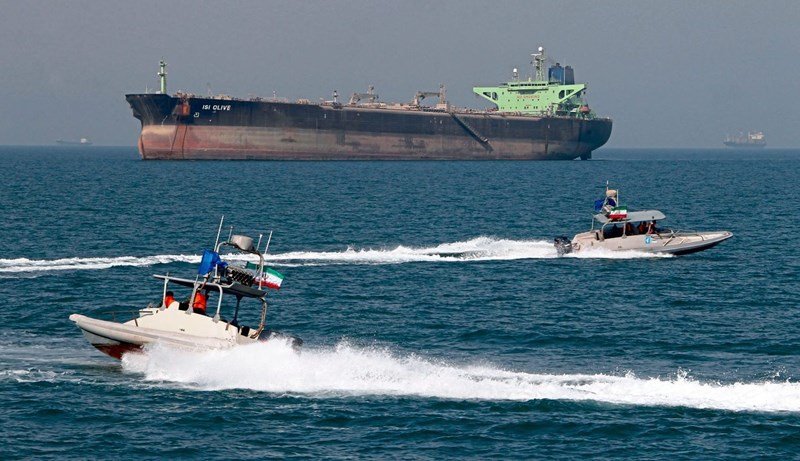
Commercial shipping remains deeply disrupted on the 18th day of the war between Iran and the US/Israeli coalition as tanker stocks build, alternative loadings expand and a limited, selective flow of vessels emerges through an unusual Larak‑Qeshm corridor – a pattern maritime risk analysts say looks like a de‑facto verification regime.
Excluding locally trading vessels, Clarksons Research counts approximately 1,100 ships representing 37m gt and $30bn in vessel value are currently inside the Gulf.
Rerouting is underway with Clarksons reporting that VLCCs heading to Yanbu on Saudi Arabia’s Red Sea coast have increased sixfold.
The cost of moving a barrel of crude from the US Gulf to Asia has doubled since the start of the year, from $5 to $10 per barrel, according to Clarksons while in bunkers, VLSFO in Singapore stands at approximately $1,100 per tonne, up 160% since the start of 2026, and Clarksons data suggests average container and bulk carrier speeds are already down 2% across March as operators slow steam to conserve fuel.
Broker BRS reports crude production shutdowns are spreading rapidly, driven by the absence of export routes and mounting storage constraints, and are now understood to be exceeding 10m barrels per day. Around 60m barrels of crude appears to be loaded on tankers trapped within the Middle East Gulf with nowhere to go, according to BRS.
Saudi Aramco is ramping up flows along its 7m barrel per day East-West crude pipeline to Yanbu, but BRS cautions that export capacity there remains constrained, estimating spare capacity of around 4.2m barrels per day – equivalent to roughly two VLCCs loading simultaneously at maximum. AXSMarine data shows at least 25 VLCCs currently ballasting toward Yanbu, with cargo counts suggesting as many as 65 VLCC fixtures from the port in March, compared with around 17 in a normal month.
The structural consequence for the VLCC market is significant. Since Middle East Gulf fixtures previously accounted for 70% of global VLCC activity, BRS warns that even accounting for increased Yanbu liftings, there will soon be too many VLCCs chasing too few cargoes – with non-Bahri tonnage already being pushed toward Atlantic loading zones, putting downward pressure on rates there.
The UAE’s critical bunkering hub and crude export terminal at Fujairah has come under fresh attack, with oil loading operations suspended following strikes both overnight and on Monday morning. The Kuwait-flagged LPG tanker Gas Al Ahmadiah was also by an unknown projectile while at anchor last night off Fujairah, suffering minor structural damage with no crew injuries or environmental impact reported.
The most consequential development of the past 24 hours may be what EOS Risk Group has identified as the beginning of an Iranian verification system governing which vessels may exit the Gulf. Martin Kelly, head of advisory at EOS Marine, confirmed that at least four vessels have transited outbound via the Strait of Hormuz in the past day following a diversion through the Larak-Qeshm Channel – a corridor between two Iranian islands that sits well off the standard traffic separation scheme.
“We could be seeing the start of a verification process by Iran whereby ships must be approved to transit via the Strait of Hormuz by calling between Larak and Qeshm,” Kelly said.
The four vessels – three bulk carriers, including two Greek-flagged and one Indian-flagged, and one Pakistan-flagged aframax tanker – were each tracked making the same unusual northward diversion toward Iranian waters before turning south into the Gulf of Oman. The Pakistan-flagged aframax Karachi, carrying Abu Dhabi’s Das crude, drew particular attention as the first non-Iranian cargo tanker to complete the crossing with AIS broadcasting continuously since the crisis began.
A new MARAD advisory has warned that Iranian forces may be contacting vessels via VHF radio or email during transit, instructing them to alter course or provide voyage information – communications US officials caution could be used to verify vessel identity or improve targeting accuracy.