‘Open the F***in’ Strait’: Trump
22 hours ago

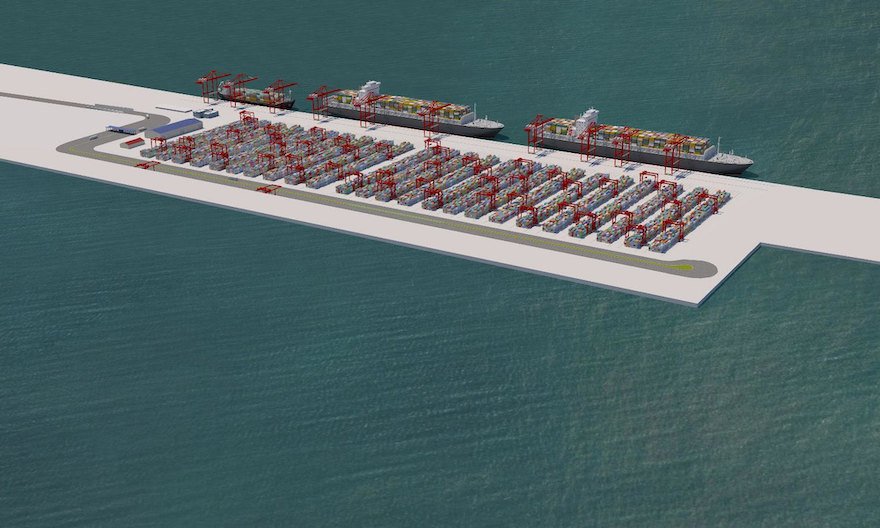
Michael Priv, founder of Blue Vector Ocean Alliance, a nonprofit corporation focused on developing next-generation coastal infrastructure to support large-scale zero-emission maritime transport, makes the case for modular floating infrastructure as tomorrow’s terminals.
For many centuries, vessels and ports were designed as fortifications against the ocean. Ports and vessels carved out safe zones in humanity’s long war against the sea. That is a bit silly. The oceans have existed for roughly 4bn years. When a flea is picking fight with a dog, who bets on the flea? In technical terms, we could say that the flea’s strategy is unsustainable, and that flea will not be pestering the dog for very much longer.
That concept is finally changing.
Across the maritime sector, fundamental reorientation is already well underway. Systems are designed to adapt, respond, and operate in continuous dialogue with the ocean. Vessels increasingly rely on dynamic positioning. Offshore energy has moved toward floating platforms that adjust to wind and waves. Autonomous systems depend on constant sensing and real-time response. Port operations are becoming data-driven and fluid, reshaping themselves around conditions rather than trying to bulldoze through them with a single rigid plan.
The one major element still catching up is the infrastructure itself. Ports rely on dredging to maintain depth, rigid structures to control movement, and repeated intervention to manage recurring problems. Dredging resets sediment conditions temporarily. Turbidity climbs in high-traffic areas. Sediment resuspension continues in a cycle that grows more expensive with every pass. The unsustainability problem is catching up with the flea.
Infrastructure can be designed to give something back to the ocean, to constructively interact with it.
A new class of modular floating infrastructure is beginning to take shape. These platforms are smart, scalable, and designed to be coupled together in configurations that match operational needs. They can be deployed where needed, repositioned as demands shift, and scaled incrementally. They move with the ocean and evolve alongside the ports they serve.
Critically, these platforms can operate anchorless. Equipped with ballast tanks and thrusters for dynamic positioning, a floating platform coupled with a dedicated, auxiliary power-plant platform or shore-based generation becomes a fully self-sustaining, precisely positioned asset that touches nothing on the seabed. It holds station, relocates when conditions or demand change, and leaves no permanent footprint. The operational envelope opens dramatically. The sky, or more accurately, the ocean, is the limit.
These platforms do far more than just float. Integrated eco-restorative elements allow the infrastructure itself to reduce turbidity, stabilize sediments, and improve water conditions where it operates. Passive filtration units function continuously without external energy input, gradually improving water quality while supporting the base of the marine food chain. The infrastructure becomes a part of the ocean.
Then there is the energy question where the relationship with the ocean turns from cooperative to genuinely productive. These floating platforms can be combined with power-plant platforms and configured to harvest solar, wind, and wave energy, including surface and oscillating water column systems. The energy these systems generate powers the main platform’s dynamic positioning, which keeps it anchorless and free, and supports on-board lighting, HVAC, cafeteria equipment, forklifts and more.
This changes the fundamental role of port infrastructure. It can contribute to port electrification and shore power for vessels, as well as its own operational systems. It restores water quality where it operates. It extends capacity where ports need it most. It enters the real definition of sustainability, where the flea finally learns to be friends with the dog.
Floating platforms provide staging capacity, reduce berth congestion by shifting selected activities offshore, and support the emerging coastal electric fleet with locally generated clean power. They extend what a port can do without forcing it to tear up what already exists.
Work in this direction is moving from concept toward implementation through efforts such as those within the Blue Vector Ocean Alliance, where modular, deployable floating systems are being structured for real-world pilot application. The next step is pilot deployments that validate placement, energy output, environmental performance, and integration with existing maritime operations under actual conditions.
Maritime systems are being built to work with the ocean. Port infrastructure is finally moving in the same direction. The flea is turning toward sustainability and a long, prosperous life with the dog. The only question is how quickly and who leads the conversation.