Fuel cleared from grounded cruise ship in Fiji | C...
12 hours ago

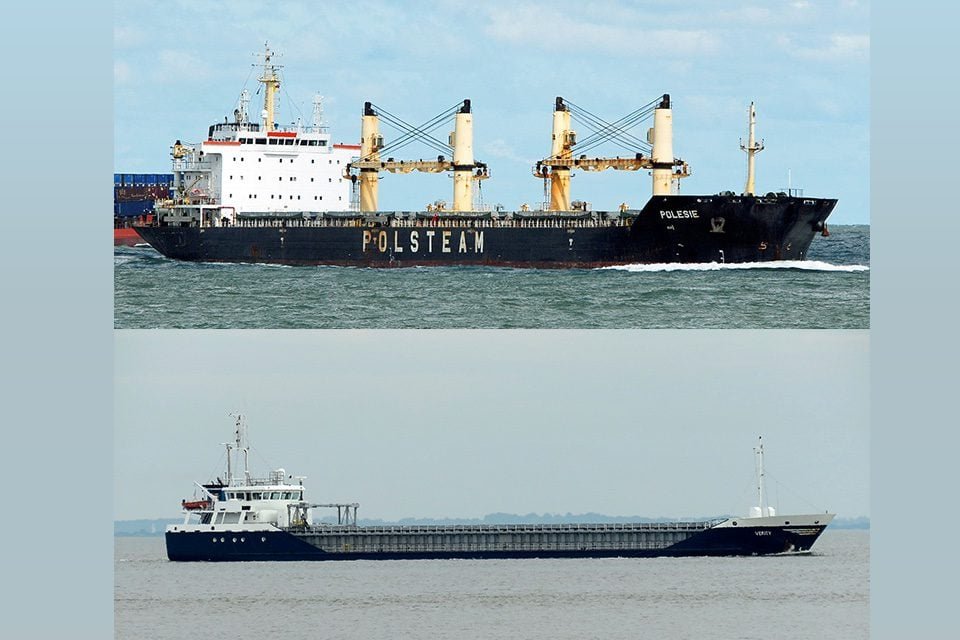
More than two years after the cargo ship Verity sank following a collision in the German Bight, the UK’s Marine Accident Investigation Branch has released its final report—and its conclusion is stark: the loss of five lives was entirely preventable.
The Isle of Man-registered Verity collided with the Bahamas-flagged bulk carrier Polesie in the early hours of October 24, 2023, inside a busy traffic separation scheme about 12 nautical miles southwest of Helgoland. The impact sent Verity to the bottom of the North Sea within minutes. Two crew members survived. Five did not.
“This accident was wholly avoidable,” said MAIB Chief Inspector Andrew Moll. “Neither vessel applied the collision regulations diligently, and both accepted passing at close range when there was no need to do so.”
The investigation found that both vessels were on a clear crossing course with ample sea room. Under the International Regulations for Preventing Collisions at Sea, Verity was the give-way vessel and required to take early and decisive action to keep clear. It did not.
Instead, both officers of the watch allowed the ships to close to dangerously short distances—never exceeding a closest point of approach of 0.5 nautical miles—while making only small, incremental course changes using autopilot. Those tentative adjustments, the report found, were insufficiently clear to signal collision-avoidance intent to the other ship or to shore authorities.
When action was finally taken, it came too late. Verity’s officer appears to have attempted to pass ahead of the larger, faster Polesie, a maneuver the report describes as contrary to the rules and increasingly risky as the gap narrowed. Polesie, meanwhile, compounded the situation by altering course to port—violating its obligation as the stand-on vessel and injecting further ambiguity into an already unstable encounter.
Even in the final minutes, investigators found that a decisive maneuver could still have prevented the collision. At 4:52:55 a.m., Polesie retained the ability to turn hard away from Verity. Instead, the officer continued making small autopilot adjustments rather than taking manual control and executing an emergency turn.
Germany’s vessel traffic services (VTS) also came under scrutiny. While operators were actively monitoring traffic, the MAIB found that their first intervention came late and lacked standard warning markers that might have conveyed urgency.
Complicating matters further, the VTS was operating on a duplex VHF channel, requiring the assistant to relay messages between the two ships rather than allowing direct communication. That setup, the report found, consumed critical seconds as the vessels closed on each other.
By the time the VTS supervisor issued a forceful instruction to Polesie, the ships were already so close that external intervention was “counterproductive.” Although the officer complied, there was no longer enough time to avoid impact.
While VHF radio is generally discouraged for collision avoidance, the report suggests that earlier direct communication could have clarified intentions and broken the dangerous stalemate that developed. Used correctly and early, radio contact might have helped—but it never came.
When Polesie struck Verity at 4:55 a.m., the damage was catastrophic. Flooding quickly overwhelmed the cargo ship, which sank before the crew could don lifejackets or immersion suits. The cold water and lack of survival equipment left little margin for survival.
Search and rescue efforts were swift and extensive, coordinated by German authorities and conducted in line with established guidance. Still, the report notes it remains unclear whether any missing crew members initially reached the surface but went undetected.
The investigation was further hampered by the absence of a voyage data recorder aboard Verity, which was not required under current regulations. With the vessel lost and the officer of the watch among the dead, investigators could not fully reconstruct the final decisions on the bridge.
The MAIB issued multiple safety recommendations, including reminders to both operators on watchkeeping discipline and collision-avoidance fundamentals. German authorities were urged to review their use of duplex VHF channels and intervention protocols, while the Isle of Man Ship Registry was encouraged to pursue expanded voyage data recorder requirements at the International Maritime Organization.
Notably, the investigation stopped short of calling for changes to the collision regulations themselves.
“This investigation has found nothing to indicate the need to amend the current rules,” the report states. “The regulations were adequate. They were simply not followed.”
The lesson, Moll said, is as old as seamanship itself: “Give-way vessels must take early, substantial action that is clearly visible to others and results in passing at a safe distance.”
The final report can be found on the UK MAIB website here.

Sign up for gCaptain’s newsletter and never miss an update