China’s LNG orders tighten slots, boost Korea’s pr...
2 days ago


China Factor examines how China’s rise is redrawing the competitive map for Korea’s key industries, and what that means for the global supply chain order. This is the third installment.
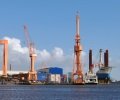
China now controls nearly two-thirds of global ship orders, but for South Korea, the real concern is not volume alone — it is that its remaining edge is no longer purely technological, but geopolitical, ecosystem-driven and increasingly time-limited.
In 2025, Chinese shipyards accounted for 63 percent of global new vessel orders, far ahead of South Korea’s 21 percent and Japan’s 5 percent, according to London-based Clarkson Research Services. Chinese state data put the figure even higher at 69 percent, underscoring Beijing’s growing dominance across the industry.
China also led the world last year in the three core metrics of new orders, ship completions and total order backlogs, reflecting the scale of its state-backed shipbuilding system, which combines industrial capacity, financing and shipping demand into a tightly coordinated ecosystem.
Yet the battle is not decided by volume alone. South Korea still commands high-value segments such as liquefied natural gas carriers, where decades of engineering experience and operational reliability make for an enduring competitive edge.
Even that lead, however, is narrowing quickly. Chinese yards are expanding into advanced vessel categories at a rapid pace, backed by steady domestic orders and state support, forcing Korean shipbuilders to rethink their long-term strategy.
“China has already caught up in many areas of shipbuilding technology,” said Rhee Shin-hyung, a professor of naval architecture and ocean engineering at Seoul National University. “In traditional shipbuilding techniques, many say there is little gap left, which may allow Korea to stay ahead for another two or three years at best. Without developing genuinely new technologies, it will be difficult to maintain a lasting edge.”
Volume matters
Behind China’s meteoric rise lies the government’s deliberate, all-out efforts to become a maritime powerhouse. Since the mid-2000s, when Beijing designated shipbuilding as a strategic industry, it has poured billions of dollars into establishing its own ecosystem that links shipyards, shipping companies and financiers in a tightly coordinated system. The goal was to become the world’s top shipbuilder by 2015.
State support has continued regardless of the market’s boom-and-bust cycles. The country’s relatively low labor costs and logistics better helped weather the storm in comparison to Japan and South Korea. Even during global downturns, Chinese yards kept growing capacity through the state owned-lender’s financial support and domestic orders.
China’s ascent was dramatic: Its share of global shipbuilding output climbed from below 5 percent at the turn of the 21st century to over 50 percent by the early 2020s. The post-2008 recovery proved particularly pivotal, as China emerged as the winner in volume and capacity, especially for bulkers, tankers and container ships.
Central to this expansion is China State Shipbuilding Corp., the world’s largest shipbuilding conglomerate that was created through the merger of two state-owned companies to curb excessive competition and consolidate market share. Armed with government-backed funding and policy advantages, CSSC and its vast subsidiaries can set prices that other rivals find difficult to match.
Industry data put the merged CSSC’s global market share at over 20 percent — greater than the combined market share of South Korea’s three top builders.
“China cannot be matched in terms of sheer output,” said retired Capt. Moon Keun-sik, a professor at Hanyang University’s Graduate School of Public Policy. “It merged the country’s largest yards into a single state-backed shipbuilder.”
Analysts say China’s shipbuilding dominance is further strengthened by a dual-use approach, under which many shipyards that build commercial vessels also produce warships for the Chinese Navy. This model has raised concerns in Washington and other countries, as profits and technological know-how from building commercial ships feed into China’s military buildup.
Korea’s last bastion: high-end ships
Despite China’s superiority in low-margin bulkers and standard containers, South Korea remains strong in lucrative, high-value segments such as LNG carriers, dual-fuel container ships, ultralarge container ships and advanced offshore platforms.
Korea’s top three shipbuilders, HD Hyundai Heavy Industries, Hanwha Ocean and Samsung Heavy Industries, control most of the production of global LNG containers, with industry estimates at around 70 percent market share. Korea’s LNG order backlog exceeds 200 units as of early 2026, far outstripping rivals in this segment.
LNG carriers require sophisticated cargo containment systems to transport the LNG at about minus 163 degree Celsius while minimizing boil-off gas. Korean shipyards have developed expertise in membrane containment technology through decades of experience and high-volume orders. Fierce competition among the “big 3” yards in Korea has also accelerated innovation and productivity.
Given that LNG projects require substantial capital investment and operate over an extended time frame, major oil companies prioritize delivery reliability, proven technical dependability and warranty and after-sales service over price alone.
Korean shipyards have maintained a strong track record, with fewer quality or delay incidents than newer competitors, industry observers say.
However, China is making inroads. Chinese yards have increased LNG carrier deliveries, raising concerns that the Korean edge could be short-lived.
As of January, Chinese shipyards had won orders of at least 13 LNG carriers already this year, compared to eight for South Korean builders. Hudong-Zhonghua and Jiangnan Shipyard, both CSSC subsidiaries, led the gains.
“Korea’s lead in the LNG market won’t last too long,” said Rhee. “There are about 1,000 LNG vessels worldwide and only a limited number of countries and companies need them to transport LNG. That means the market is structurally limited.”
Rhee explained that by steering domestic orders of LNG to state-owned yards, China is able to accumulate operational experience and technical know-how. “Their technology is bound to improve with continuous orders.”
Supply chain, key parts
Observers say another area where China still falls short is in the critical components that go inside high-value vessels such as large cruise ships, LNG carriers and aircraft carriers.
While Chinese shipbuilders excel in hull construction and can produce most components needed for conventional bulk carriers, they remain heavily dependent on foreign supplies for advanced vessels requiring sophisticated systems and equipment.
China’s most advanced vessels, like luxury cruise liners and specialized LNG carriers, are estimated to contain only 30 to 40 percent domestically components, with the remainder being sourced from South Korea, Europe and Japan, according to industry sources.
A recent editorial in China’s state-run Global Times acknowledged lingering challenges, saying that “some core equipment and key materials still rely on imports” and that gaps remain in design optimization for large LNG carriers.
In particular, Chinese shipyards rely heavily on Korean engines, including dual-fuel engines for methanol and ammonia, used in container ships.
According to data from the Korea International Trade Association, South Korean exports of ship engines and related components to China totaled $1.29 billion last year, up 24 percent from a year earlier.
“China has secured the majority of the eco-friendly vessel orders recently, yet the engines inside, which are the core components, are often sourced from South Korea,” said a shipbuilding industry official. “But China is also accelerating efforts to localize engine production, and maintaining a technological lead will be a key challenge for Korean manufacturers.”
Geopolitics: Korea’s new shipbuilding edge?
Geopolitical tensions between Washington and Beijing have created openings for South Korean shipbuilders, observers say. Some Western shipping companies are diversifying orders away from China to reduce the political risk, in turn benefiting Korean yards.
In October 2025, the US imposed significant port fees on vessels made, owned or operated by China, triggering alarm among shipping companies with Chinese-built ships in their fleet. China responded with reciprocal measures, introducing port fees on vessels with US ties. While the two sides reached a deal for a yearlong pause, these measures could return late this year.
Against this security backdrop, industry officials say Korea could leverage closer cooperation with the US as one of a few viable options to counter China’s dominance.
Under the “Make American Shipbuilding Great Again” initiative, Seoul and Washington have been exploring joint projects.
“Korea can provide infrastructure and operational know-how, while the US supplies cutting-edge technology,” said Rhee. “If we combine those strengths in shipbuilding, it can become a true win-win cooperation and may be the only way to beat China.”
Moon echoed the view on the need for deeper partnership with the US in shipbuilding.
“If Korea and the US jointly standardize LNG vessels and related products and set global benchmarks, it becomes much harder for China to enter the market,” the professor said. “That requires strong policy support.”
He added that Korea’s growing shipbuilding investment in the US has already drawn Beijing’s attention. “If the two truly join forces, the impact will be significant and China knows that.”
Source: The Korea Herald