S. Korean Government To Curb Foreign Shipbuilding ...
9 hours ago

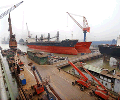

As China’s shipbuilding industry has aggressively increased orders for liquefied natural gas (LNG) carriers since the start of the year, some analysts say the move is paradoxically serving as a lever that boosts Korean shipbuilders’ bargaining power on prices. As China’s major shipyards chew through large volumes of low-priced orders and exhaust construction slots for delivery even after 2029, the reasoning goes, Korea will enjoy a dominant position for upcoming orders of high value-added vessels.
According to the shipbuilding industry and the financial investment sector on the 13th, the three Korean shipbuilders—Samsung Heavy Industries, HD Korea Shipbuilding & Offshore Engineering, and Hanwha Ocean—dismissed concerns about a China-led supply glut during their recent earnings conference calls, instead interpreting it as an opportunity to raise vessel prices and improve profitability.
China’s Hudong-Zhonghua Shipbuilding and Jiangnan Shipyard each won orders for four LNG carriers last month from shipping company TMS Cardiff Gas and Shell, respectively. As Chinese yards kicked off an order-winning relay early in the year, touting price competitiveness about 10% cheaper than Korea, some in the industry voiced concerns that the LNG carrier stronghold where Korea excels could be eroded, pushing down prices and worsening profitability.
According to Clarksons Research, the ship new building price for a 174,000-cubic-meter LNG carrier peaked at $265 million in Feb. last year before turning downward, and has stayed at around $248 million for four consecutive months recently, showing a weak trend.
◇”China’s depletion of low-priced slots boosts Korea’s pricing power”
In this situation, Samsung Heavy Industries said the string of low-priced LNG carrier orders by Chinese shipbuilders is actually “a boon for Korean shipbuilders.” According to Korea Investment & Securities Co., Samsung Heavy Industries said during its fourth-quarter earnings conference call on Jan. 31 that “as Chinese shipyards’ Qatar volumes are being scheduled for deliveries in 2030–2031, slots in China are being exhausted,” adding, “Korea will capture the benefits from upcoming U.S. volumes.”
That, some say, could translate into stronger bargaining power for Korean shipyards. Samsung Heavy Industries said, “We expect domestic shipyard slots to also tighten, so LNG carrier prices are forecast to rise before we enter the second half of the year,” adding, “We will use this opportunity to focus on U.S. projects.” The explanation is that as China’s low-priced order slots are used up, shipowners’ options narrow to Korea, increasing the likelihood of price hikes.
Hanwha Ocean also saw limited impact from China’s volume offensive. On a conference call, Hanwha Ocean said of concerns about low-priced orders from China, “There are indeed factors whereby recent prices contracted in China put downward pressure on Korea’s order prices,” but added, “We see the amount that can go to China as limited in the market.”
It went on to say, “Even if China has capacity it can supply, if market demand exceeds a certain level, the linkage between Korean construction prices and China will weaken.” In other words, if orders pour in beyond what China can absorb, shipowners will ultimately have no choice but to follow the pricing policies of Korean shipyards—a decoupling.
HD Korea Shipbuilding & Offshore Engineering dismissed the threat from China by emphasizing market differentiation and a technology gap. Lee Woo-seok of HD Korea Shipbuilding & Offshore Engineering said on a conference call, “Although there is talk that Hudong-Zhonghua can produce 30 ships a year and Jiangnan Shipyard nearly 10, it is hard to see them actually using all of that capacity,” adding, “Jiangnan is working hard, but we understand that in terms of quality and technology it still falls short compared with Korea.”
He added, “In fact, in international tenders other than Chinese volumes, there is a tendency for Chinese shipbuilders to be excluded,” and said, “For example, in recent projects such as Cheniere, Mozambique, and Equinor, Chinese shipbuilders’ participation continues to be excluded, so Korean shipyards’ market share will remain intact.”
◇More than 80 LNG carrier orders expected this year… focus on U.S. projects
The next “big catch” that all three are commonly eyeing is the United States. That is because large-scale LNG project investments were finalized last year, aligned with the Donald Trump administration’s policy to expand energy exports. In particular, U.S.-origin projects can also benefit from the “ton-mile” effect, where longer transport distances require more ships.
Oh Ji-hoon, an analyst at IBK Securities, explained, “Usually one LNG carrier is needed to transport 1 million tons of LNG, but for shipments from the United States to Asia, the longer distance requires 2.2–3 ships.” The capacity of LNG liquefaction plants worldwide for which final investment decisions were made last year totals 84 million tons per year, of which U.S. volumes account for 61 million tons, or about 73%.
The industry expects global orders for LNG carriers this year to more than double from last year. Samsung Heavy Industries projected that global LNG carrier orders will reach 80–100 ships this year, and Hanwha Ocean also expected a similar level.
HD Korea Shipbuilding & Offshore Engineering said, “Projects currently under discussion are progressing quite a bit on a base of increased prices,” adding, “Vessel prices will steadily rise this year.” As Korean shipbuilders have already secured more than three years’ worth of work, they plan to stick to a selective order-taking strategy—picking only shipowners who pay proper prices instead of competing excessively.
Source: ChosunBiz