Hafnia inks $405m deal for eight product tankers a...
1 day ago

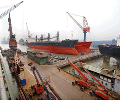
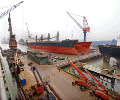
Orders for crude oil carriers are rapidly increasing, driven by the demand for replacing aging vessels coupled with the conflict between the United States and Iran. Furthermore, with the strengthening of ship environmental regulations, the upward trend in new demand is expected to continue for the time being.
According to industry sources on March 25, Hanwha Ocean announced on the same day that it had secured an order for three Very Large Crude Carriers (VLCCs) from an Oceania-based shipowner for approximately 588.7 billion won (approximately $392.5 million). Previously, Samsung Heavy Industries also received an order for three VLCCs from a Bermuda-based shipping company for approximately 400.1 billion won.
nd in new orders will accelerate due to Iran’s potential blockade of the Strait of Hormuz in the aftermath of the war. This is because an increasing number of crude oil carriers are opting to bypass the Cape of Good Hope in Africa, as the Strait of Hormuz, through which approximately 20% of the world’s crude oil volume passes, could be blocked. As transportation distances increase, shipowners require more crude oil carriers.
According to the Baltic Exchange, the freight index for crude oil carriers on the Middle East-China route recorded 400.6 on March 20, a sharp increase of 78.3% compared to 224.72 on Feb. 27, just before the outbreak of the war. This is approximately eight times higher than at the beginning of the year. An industry official stated, “As geopolitical instability intensifies, some shipowners are accelerating their orders ahead of their planned schedules.”
While domestic shipbuilders are expected to benefit, concerns are also being raised as a significant portion of new orders is concentrated in China. Indeed, it has been revealed that China has secured over 70% of the crude oil carriers ordered this year. China’s Hengli Shipbuilding holds the top position in the global crude oil carrier order backlog, followed by Hanwha Ocean. Chinese shipbuilders are expanding their global market share by leveraging price competitiveness and faster delivery times.
Another industry official projected, “If Chinese shipbuilders’ slots (docks) are quickly utilized, a trickle-down effect for Korean shipbuilders can also be expected,” adding, “Even excluding war factors, the mid-to-long-term boom will continue, and ship prices will also keep rising.”
Source: Business Korea