Marinakis plans Oslo listing of new giant tanker p...
7 hours ago


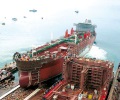
The government and the domestic shipbuilding industry are moving to secure Korean skilled workers. While the shipbuilding industry continues to boom with a flood of incoming orders, it remains plagued by a chronic labor shortage and a structure of dependence on foreign workers. With the launch of the MASGA project approaching and the urgent need to attract skilled workers, voices are also calling for government support to cultivate shipbuilding talent.
According to the shipbuilding industry on Feb. 24, HD Hyundai plans to minimize the hiring of foreign workers going forward and prioritize Korean workers for on-site positions. Starting this year, positions vacated by foreign workers whose employment contracts expire will be filled with Korean workers. The policy is to conduct both new and experienced hiring for Korean workers.
The prevailing interpretation is that this move is in response to President Lee Jae-myung’s recent remarks on the shipbuilding industry’s dependence on foreign workers. At a town hall meeting in Ulsan on Jan. 23, President Lee pointed out, “What benefit does hiring foreign workers at low wages bring to the local economy?” and “It may be advantageous for shipbuilding companies, but hasn’t it taken away opportunities from local workers?” The argument is that the excessive increase in foreign hiring is threatening domestic youth employment and hindering the revitalization of local economies.
Foreign workers in the shipbuilding industry have increased rapidly since the introduction of the shipbuilding-specific quota for E-9 (non-professional employment) visas in 2023. Quotas of 5,000 were allocated in 2023 and 2024, and 2,500 last year. The proportion of foreign workers, which was around 5% in 2021, has now risen to over 15% of all shipbuilding workers.
The problem is that long-term employment of foreign workers is difficult due to visa duration limits and other restrictions. A shipbuilding industry official said, “The field needs permanent-type skilled workers who can work for extended periods,” adding, “While cultivating domestic engineers is the best option, we are having difficulty securing workers due to young people’s avoidance of regional areas and the high work intensity, so the structure of dependence on short-term foreign labor continues.”
There are also considerable voices calling for government support to expand domestic employment. The explanation is that there are structural limitations in attracting workers because major domestic shipyards are located in regions avoided by young people, such as Ulsan and Geoje. Samsung Heavy Industries and Hanwha Ocean have established R&D (research and development) hubs in Busan, which has relatively better accessibility, and are focusing their efforts on attracting and cultivating talent.
The importance of Korean workers is expected to grow further when the MASGA project becomes operational. This is because if domestic skilled workers are dispatched to the United States for extended periods, operational gaps may occur at sites in Ulsan, Geoje, and other locations. While shipyards are expanding the adoption of robots to cope with the labor shortage, the assessment is that this is merely a supplementary measure and cannot be considered a fundamental solution.
Lee Jang-hyun, a professor in the Department of Naval Architecture and Ocean Engineering at Inha University, said, “In the order-winning process, the scale of skilled workers a shipbuilding company possesses becomes competitiveness in itself,” adding, “From the perspective of protecting domestic technology as well, expanding Korean hiring to cultivate talent is desirable.” He added, “It is also necessary to simultaneously prevent the phenomenon of highly skilled welding workers leaving for other industries such as semiconductors.”
Shipbuilding companies are expanding performance bonus payments to prevent the departure of skilled workers. Hanwha Ocean has decided to pay performance bonuses based on the same criteria to both prime contractor and subcontractor workers for the first time in the industry, and Samsung Heavy Industries is also paying 208% of the same bonus base amount as the prime contractor to in-house subcontractor employees with more than 5 years of service. The government also plans to establish a new ‘Shipbuilding Industry Win-Win Cooperation Package’ worth 10.4 billion won this year to improve wages and welfare at subcontractors.
Source: Business Korea