Jinhui orders bulker duo in China as fleet renewal...
2 hours ago

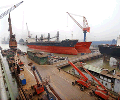

As the three major domestic shipbuilders (HD Korea Shipbuilding & Offshore Engineering, Hanwha Ocean, Samsung Heavy Industries) posted record results in the third quarter on the back of orders for high value-added ships, the outlook is that from the fourth quarter, management of “non-manufacturing risks,” such as exchange rates and policy changes, will determine performance.
According to the shipbuilding industry on the 5th, the combined operating profit of the “big three” shipbuilders in the third quarter of this year was 1.5 trillion won, tripling from a year earlier. HD Korea Shipbuilding & Offshore Engineering’s third-quarter operating profit this year came to 1.0538 trillion won, up 164.5% from a year earlier. Hanwha Ocean (269.4 billion won) and Samsung Heavy Industries (238.1 billion won) also saw operating profit improve significantly.
The reason for the solid third-quarter results was an increase in orders for high value-added ship types such as liquefied natural gas (LNG) carriers. LNG carriers accounted for about 70% of HD Hyundai Heavy Industries’ total sales and about 60% for Hanwha Ocean. Samsung Heavy Industries in Aug. also won an order for six LNG carriers worth 2.1 trillion won.
At their third-quarter earnings conference calls, each shipbuilder agreed that it has become a time when “risk management” is more important. Shipbuilders are first working to reduce their sensitivity to the won-dollar exchange rate against the dollar. Typically, because shipbuilders receive export payments for ships in dollars, when the won-dollar exchange rate rises, won-converted revenue increases. They conduct some currency hedging for risk management, but the unhedged portion remains exposed to exchange rate fluctuations.
Unexpected construction cost increases and one-off cost fluctuations are also variables. HD Korea Shipbuilding & Offshore Engineering incurred an additional 25 billion won in its offshore plant division. Hanwha Ocean spent 50 billion won on one-off costs related to the P-79 floating production storage and offloading (FPSO) accident, as well as wage and collective bargaining settlement costs. Samsung Heavy Industries also recognized 40 billion won in wage and collective bargaining settlement costs.
Business uncertainty has also grown due to policy changes by governments. The U.S. and Chinese governments decided to impose port entry taxes on counterpart countries’ ships entering their ports but then decided to defer the measure for a year, leaving uncertainty in place. As shipowners’ investment sentiment weakens, ship orders are also declining. According to Clarkson Research, a U.K.-based shipbuilding and shipping market specialist, global cumulative orders for Jan.–Sep. this year were 32.64 million CGT (compensated gross tonnage) and fell 47% from 61.43 million CGT a year earlier.
A shipbuilding industry official said, “In the past, improving internal productivity at shipyards determined performance, but going forward, defending against external variables is more important. We think profit will depend on how quickly costs arising from the macroeconomic environment, policy changes, and contract structures are passed on to ship prices.”
Source: The Chosun Daily