HD Hyundai drives Korea’s shipbuilding future with...
10 hours ago

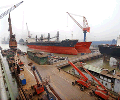
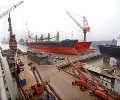
As environmental regulations driven by the climate crisis put pressure on the entire shipbuilding and shipping industry, the domestic shipbuilding sector is accelerating the development of ships using ammonia, considered a carbon-free fuel.
According to a report published by the Korean Register (KR) on April 23, the shipping sector accounts for approximately 2.9% of global carbon emissions.
The International Maritime Organization (IMO) adopted its Initial GHG Reduction Strategy in 2018, setting a goal to halve carbon emissions from shipping by 2050. The European Union (EU) has also been directly imposing the cost of carbon emissions by including the shipping sector in its Emissions Trading System (ETS) starting from 2024.
Amid these changes in the policy environment, shipping companies are treating greenhouse gas reduction and the development of eco-friendly ships as a necessity, not a choice, and are moving to secure alternative eco-friendly fuels to replace conventional heavy oil.
Among these, ammonia is considered the most promising alternative. Composed of nitrogen and hydrogen, ammonia is a carbon-free fuel that does not produce carbon dioxide when combusted. Its characteristic of liquefying at minus 33℃ makes it relatively easy to store and transport. Another advantage is that a production and transportation infrastructure of about 180 million tons per year is already in place.
However, a technical limitation currently exists as its high auto-ignition temperature of 651℃ makes combustion difficult, requiring some pilot oil (ignition fuel).
In line with this trend, the three major domestic shipbuilders are each taking different approaches to secure a leading position in the ammonia-powered ship market.
HD Hyundai Heavy Industries proved its technological prowess by successfully building the world’s first ammonia-powered ship on the 9th. The vessel is a 46,000 m³-class medium-sized gas carrier equipped with an ammonia dual-fuel (DF) engine. This system uses both ammonia and conventional fuel.
Furthermore, it enhances eco-friendly performance by incorporating a shaft generator for power production and a nitrogen oxide (NOx) reduction system. Safety has also been secured by installing a real-time ammonia leak detection and emission recovery system.
Hanwha Ocean is focusing on achieving a completely carbon-free vessel that uses only ammonia as fuel.
In an op-ed released last January ahead of the World Economic Forum (WEF, Davos Forum) Annual Meeting, Hanwha Group Vice Chairman Kim Dong-kwan stated, “Hanwha Ocean is pursuing the development of carbon-free ships by applying innovative technologies such as ammonia gas turbines,” emphasizing the company’s commitment to securing decarbonization technology.
The core of this effort is ammonia gas turbine technology. This technology aims for 100% ammonia combustion, enabling propulsion without the need for pilot fuels like diesel, unlike conventional methods.
Hanwha Ocean and Hanwha Power Systems are collaborating with American energy technology company Baker Hughes to develop this technology, a world-first, with a target completion date of 2028.
A Hanwha Ocean official explained, “Because ammonia has a high combustion temperature of over 600 degrees, it is difficult to ignite on its own, traditionally requiring about 5% pilot fuel. The gas turbine system Hanwha is developing independently will enable combustion and propulsion using only ammonia.”
Samsung Heavy Industries has opted for a method that converts ammonia into hydrogen for use. Samsung Heavy Industries received an Approval in Principle (AiP) from the French classification society Bureau Veritas (BV) in 2025 for its ‘ammonia-based hydrogen fuel cell-powered crude oil carrier’.
This method involves separating ammonia into hydrogen and nitrogen, extracting the hydrogen, and then supplying it to a fuel cell to generate electricity through a chemical reaction between hydrogen and oxygen. This approach has the advantage of securing both eco-friendliness and efficiency by producing power without a combustion process.
An industry expert stated, “We are researching and developing various eco-friendly fuel technologies, including ammonia,” adding, “We foresee the eco-friendly ship market evolving in a direction where multiple energy sources, such as Small Modular Reactors (SMRs), are used together in the future.”
Source: Business Korea