Damen ASD Tug 2713 Fuel Flexible receives class an...
2 hours ago

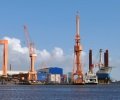

A major industrial labor union has launched a membership drive targeting migrant workers at Hyundai’s shipbuilding complex in Ulsan, seeking to expand its reach to tens of thousands of subcontracted workers — many of them foreign — as members prepare for new talks with the company.
A senior official at the Korean Metal Workers’ Union (KMWU) said the campaign’s goal is to integrate migrants, a rapidly increasing demographic in shipyards, into the union so they can be covered by collective bargaining and formal representation.
“In many workplaces, especially in the shipyards, the number of migrant workers is growing rapidly, and they are often forced to endure poor conditions while left in a blind spot in terms of their rights,” the official told The Korea Times Monday.
The three-day campaign includes early morning leaflet distribution at the shipyard gates, multilingual leaflets and QR code surveys, and trucks broadcasting messages in different languages, including English, Chinese, Nepali and Vietnamese, aimed specifically at migrant workers.
He said the recent passage of amendments to the Trade Union Act, commonly known as the “yellow envelope law,” has opened the way for subcontracted employees — a status that covers most migrant workers in the shipyard — to negotiate directly with principal employers such as Hyundai. Under the campaign, the union is urging not only migrants but also Korean workers hired on fixed-term contracts by Hyundai itself to join, so that the union can represent them as they seek to secure better working conditions for all employees.
According to the KMWU, HD Hyundai Heavy Industries’ Ulsan shipyard relies on a workforce of around 40,000 people, including roughly 15,000 directly employed by the firm and 25,000 working for subcontractors, many of them foreign workers. The union says that without this pool of subcontracted and migrant labor, “not a single ship could leave the yard.”
The recent shipbuilding boom has deepened this reliance. As many Korean skilled workers have left the yards after years of low pay and harsh conditions, employers have increasingly turned to migrant workers to fill labor shortages. This has made them a structural part of the workforce, not a marginal supplement. So for the union, integrating foreign workers into the group now is not only an issue of rights and equality but also a strategic necessity for effective collective bargaining in the shipbuilding industry.
“The government and management are filling the gap by driving migrant workers into low-wage, long-hour jobs. This is the reality behind the facade of what has been promoted as ‘K-shipbuilding,’” the union said in a statement. “The more subcontracted and migrant workers join and participate in the union, the greater our social strength becomes — and the stronger our hand at the bargaining table.”
But for many migrant workers, joining a union still carries risks, from possible retaliation at subcontracting firms to uncertainty over their visa status. There are no official statistics in Korea that separately track union membership rates among foreign workers. However, with overall union density among Korean workers hovering around 13 percent, experts speculate that the rate for migrants is significantly lower.
Source: The Korea Times