Supreme Court rules Hanwha Ocean bonus not wages, ...
11 hours ago

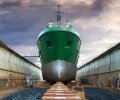

HJ Shipbuilding & Construction, based at the Yeongdo Shipyard in Busan, secured an order worth 353.2 billion Korean won on the 10th of last month for two 11,000 TEU (1 TEU equals one 20-foot container) eco-friendly container ships from a European shipping company. This marks the first time in approximately 90 years since the shipyard’s establishment that it has received an order for a container ship exceeding 10,000 TEU. For shipyards, building a single large vessel is more profitable than multiple smaller ones. However, Yeongdo Shipyard struggled to secure such orders due to its dock length of only 300 meters, making it difficult to construct large ships typically ranging between 300–400 meters.
HJ Shipbuilding & Construction overcame this limitation through technological innovation. By widening the hull horizontally compared to conventional container ships and maximizing cargo space efficiency with advanced design technology, the company maintained the total capacity of 11,000 TEU while finding a way to build large container ships within the narrow dock. This solution emerged from efforts to enhance profitability.
Last year, mid-sized shipbuilders—including HJ Shipbuilding & Construction, Daehan Shipbuilding, and K Shipbuilding—saw their operating profits more than double compared to the previous year, demonstrating growth comparable to the “Big 3” shipbuilders: HD Hyundai, Hanwha Ocean, and Samsung Heavy Industries. A key factor in their success was the development of new specialties despite various constraints. Notably, these mid-sized firms invested in eco-friendly ship manufacturing and design technologies during a decade-long industry slump, efforts that are now bearing fruit amid the current industry boom.
Mid-Sized Shipyards Sharpening Their Specialties Amid Downturns
Recent financial results from mid-sized shipyards show clear improvements. Daehan Shipbuilding’s operating profit surged 86% to 294.1 billion won last year. HJ Shipbuilding & Construction also recorded an operating profit of 67 billion won, an 825% increase from the previous year. K Shipbuilding, which is about to release its full-year results, saw its operating profit for the first three quarters of last year reach 84.7 billion won, seven times higher than its total profit for the entire previous year.
Daehan Shipbuilding’s profitability improved as it expanded its focus to high-value products. A decade ago, its mainstay was Aframax-class crude oil carriers (80,000–120,000 tons), but in recent years, it has broadened its expertise by developing Suezmax-class carriers (120,000–200,000 tons). This required investments to enhance capabilities in producing and assembling thicker, heavier ship blocks. The results are evident this year: the company secured orders for eight Suezmax-class crude oil carriers in January and February alone, worth 1.2 trillion won.
Additionally, its focus on shuttle tankers—a high-value product—since 2024 has positively impacted performance. Shuttle tankers are specialized vessels that transport crude oil directly from offshore drilling platforms to onshore facilities. They require high-value positioning equipment to remain stationary during oil transfers, making them a premium product.
K Shipbuilding learned from past failures during the STX Shipbuilding era, when excessive diversification into ultra-large container ships and offshore plants led to financial troubles. Instead, it restructured its business around petrochemical tankers (MR tankers), which were its former mainstay. Recent geopolitical events, including the Russia-Ukraine war and the Red Sea crisis, extended transportation times for petrochemical products, increasing demand for MR tankers. K Shipbuilding capitalized on this trend, securing 15 orders last year and five more in the first two months of this year.
◇Eco-Friendly Diversification as the Future
Mid-sized shipyards are now preparing to enter the eco-friendly ship market, traditionally dominated by larger competitors. The goal is profitability: eco-friendly ships, which incorporate advanced emission-reducing technologies, can be sold at higher prices than conventional vessels of the same size. K Shipbuilding, for instance, received Basic Design Approval (AIP) from the Norwegian classification society DNV in September last year for its next-generation LNG bunkering vessel. Dubbed the “floating gas station,” this specialized ship supplies fuel to LNG-powered vessels. K Shipbuilding plans to leverage this certification to pursue orders for eco-friendly gas carriers.
Source: The Chosunilbo