Robotization Wave Hits Shipyards | Hellenic Shippi...
1 hour ago

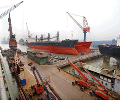

After the United States revealed Japan’s first set of investment plans under its $550 billion commitment, calls are growing for Korea to take faster action on its U.S. investment plans to allay tariff pressures and secure its position in profitable sectors.
Experts say shipbuilding can be a good start, as the U.S. has been actively seeking Korea’s participation in reviving its shipbuilding industry. Its Maritime Action Plan, announced last week, seemed to reaffirm that commitment.
These calls came after Japan announced Wednesday that it will invest in three projects worth $36 billion: constructing an artificial diamond manufacturing facility in Georgia, a natural gas power plant in Ohio and a deepwater crude oil export facility off the Texas coast.
“The scale of these projects is so large, and could not be done without one very special word, TARIFFS,” U.S. President Donald Trump wrote on his social media account.
The progress made between Washington and Tokyo is creating pressure for Korea. Trump threatened on Jan. 26 to raise tariffs on Korean goods to 25 percent, the level prior to settling on 15 percent in a bilateral agreement reached last November, citing delays in relevant legislation at Seoul’s National Assembly.
In response, the Assembly set up a special committee to expedite the processing of bills that provide legal grounds for Korea’s investment in the U.S., while the government also sent a negotiation team to the U.S. on Wednesday to accelerate feasibility studies for various projects.
With Japan having already presented tangible plans, we may need to move at a similar pace and consider stepping up our current efforts in terms of preventing further tariff impacts,” said Jang Sang-sik, head of trade trend analysis at the Korea International Trade Association.
“Given that there will be only a limited number of commercially viable projects (in U.S. investment), if Japan actively secures the more attractive ones first, Korea may be left with less profitable opportunities.”
Among the three projects revealed by Washington and Tokyo, the natural gas power plant and the offshore crude oil facility are areas where Korean companies have also demonstrated strengths.
Jang said that shipbuilding is one area where Korea can accelerate its efforts to advance U.S. investment plans, noting that the sector played a critical role in the two countries reaching a tariff agreement in November.
The Seoul-Washington tariff agreement consists of a $150 billion commitment to the American shipbuilding industry and a $200 billion commitment in advanced industries.
According to America’s Maritime Action Plan, revealed on the White House website, the U.S. notes that Trump has secured “at least $150 billion of dedicated investment for America’s shipbuilding industry,” apparently counting Seoul’s $150 billion commitment as one of the key resources for revitalizing its shipbuilding industry.
Also, the report notes a “Bridge Strategy,” under which initial vessels may be constructed in allied shipyards, including those in Korea, while its domestic shipyard capacity is expanded through targeted capital investments.
For Korean shipbuilders, the report is meaningful because it is interpreted as reaffirming Washington’s commitment to its shipbuilding industry. Although the initial phase may involve only limited production, it is seen as a positive signal given the likelihood of orders being placed with Korean shipyards.
“I believe the shipbuilding sector could be a good start,” Jang said. “As this is also tied to political considerations, there is a need to move forward with greater speed to help Trump take credit for progress. With the U.S. midterm elections approaching, he is likely to push for quicker results. It would be less burdensome for Korea to begin with areas where it has clear strengths.”
Along with shipbuilding, modernizing the U.S. power grid is also cited as an area where the two countries can cooperate, as electricity demand is surging there due to the expansion of artificial intelligence data centers. Korea is seen as competitive in areas such as high-voltage transmission technology.
Projects involving natural gas power plants, solar energy, energy storage systems and small modular reactors are also being viewed as potential areas for collaboration.
Source: The Korea Times