Norwegian shipowner offloads another 2016-built ve...
1 hour ago

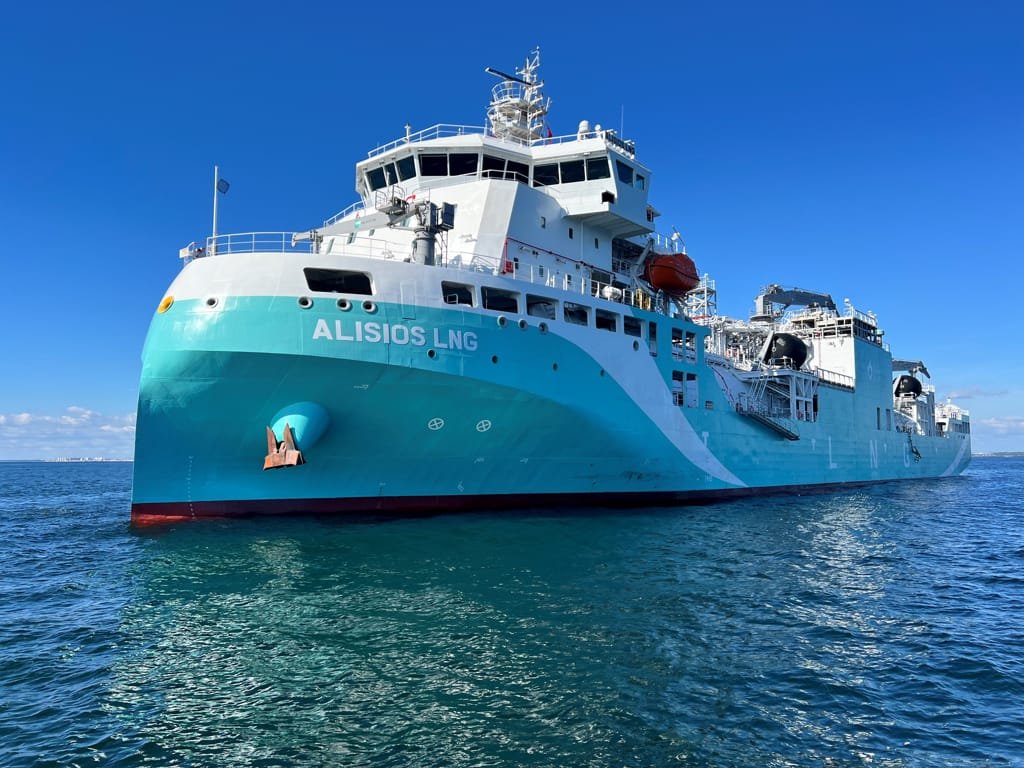
Enagás, a Spanish company that operates and maintains gas pipelines and terminals, and Axpo, Switzerland’s largest energy producer and an international player in energy trading and the marketing of solar and wind power, have rolled out a new liquefied natural gas (LNG) bunkering vessel in southwestern Spain.
The launch of an LNG bunkering vessel, named Alisios LNG, at the port of Huelva in southwestern Spain was done by Arturo Gonzalo, Enagás’ CEO, and Ignacio Soneira, Axpo Iberia’s Managing Director. The vessel, owned by Enagás through its Scale Green Energy subsidiary and chartered by Axpo for commercial use, is expected to operate along the southern coast of the Iberian Peninsula and promote the use of LNG and bio-LNG as transitional fuels for maritime transport.
Gonzalo underlined: “Today’s launch is a key milestone in the development of infrastructure that contributes to the decarbonisation of the maritime sector. The adoption of more sustainable fuels, such as LNG and bio-LNG, also supports compliance with European emission reduction targets.”
The 12,500-cubic-meter (cbm) capacity vessel supports the decarbonisation of maritime transport, enabling the growing use of LNG and bio-LNG by the sector. The project strengthens the firms’ roles in the energy transition, expanding their LNG bunkering capacity.
Working from one of its loading terminals in Spain, the Alisios LNG is said to incorporate advanced technology to minimise emissions during operations. Supplying both LNG and bio-LNG for maritime transport, the ship is forecast to help further the decarbonisation of the maritime sector.
Soneira highlighted: “Commissioning this new vessel further consolidates Axpo’s leadership in the small-scale LNG bunkering business as we continue our efforts to help the transition to decarbonise maritime transport.”
The vessel’s advanced control systems are deemed to give greater manoeuvrability, allowing it to operate in a variety of different port environments. With new European regulations requiring a progressive reduction in maritime sector emissions, the vessel commissioning is seen as enabling Enagás and Axpo to respond to increased demand for alternative fuels from the industry.
This ship is described as a versatile, efficient and reliable vessel for the supply of more sustainable fuels, equipped with technology designed to maintain its cargo in the best condition throughout the voyage. The use of LNG as a marine fuel in Spain is perceived to have the ability to curb CO2 emissions by around 2 million tonnes by 2030, equivalent to replacing more than 1 million internal combustion vehicles with electric vehicles.
While Enagás operates four vessels, Alisios LNG, Levante LNG, Mistral LNG, and Haugesund Knutsen, Axpo continues to expand its bio-LNG portfolio and forge partnerships with industry leaders, as illustrated by the ten-year charter of the Green Pearl LNG bunkering vessel in Italy. The 7,500 cbm vessel transports and distributes LNG and bio-LNG, improving the speed, flexibility, and efficiency of the company’s small-scale LNG bunkering operations across the Mediterranean.
Axpo elaborated: “LNG bunkering in Spain has grown exponentially over recent years, with activity quadrupling between 2023 and 2025. Last year, LNG cargoes grew by 64 per cent in Spain, positioning it as a strategic hub in southern Europe for the supply of alternative fuels.
“As the number of bunkering vessels and supporting infrastructure continues to expand, LNG and bio-LNG are currently the best-placed alternative fuels to lead the maritime sector’s energy transition. Compared to traditional fuels, LNG eliminates 100 per cent of sulphur oxide (SOX) emissions, between 80 to 90 per cent of nitrogen oxide (NOX) emissions and 25 per cent of CO2 emissions.”

Take the spotlight and anchor your brand in the heart of the offshore world!
Join us for a bigger impact and amplify your presence at the core hub of the offshore energy community!