
Tougher Standards and Enhanced Oversight Mark Laun...
2 hours ago

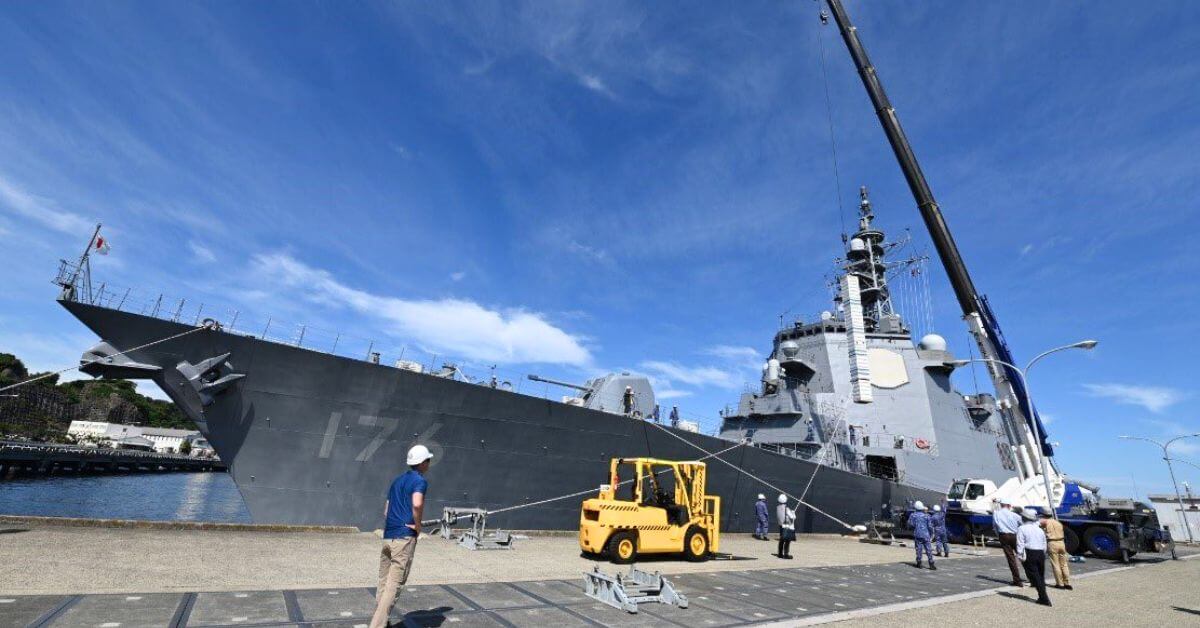
Japan has sent its Kongo-class destroyer JS Chokai to the United States to undergo upgrades and crew training that will make it the country’s first warship capable of operating Tomahawk cruise missiles.
The Japan Ministry of Defense (MOD) confirmed that Chokai departed Yokosuka on September 27 for San Diego, California. The ship will be modified and its crew will undergo intensive training to ensure early operational use of Tomahawks once deliveries begin.
Ahead of departure, the Japan Maritime Self-Defense Force (JMSDF) conducted Tomahawk missile-handling training at Yokosuka Base on September 26.
The exercise used dummy rounds and was supported by the U.S. Navy. According to the MOD, the drills were designed to familiarise the crew with missile-loading procedures and confirm the destroyer’s safety management systems. A video of the training and the ship’s departure was later shared by JMSDF on social media.
#JMSDF conducted a #Tomahawk mock loading drill on “#JS_CHOKAI” with support from the @USNavy.
Our stand-off defense capabilities are steadily progressing as we strengthen ties with the U.S. Navy and build readiness.#FOIP #FreeandOpenIndoPacific pic.twitter.com/uiU8zV33UB
— 防衛省 海上自衛隊 (@JMSDF_PAO) September 26, 2025
The MOD described Chokai’s U.S. mission as proof of “steady progress” in the Tomahawk program and highlighted the importance of strengthening deterrence and response under the Japan-U.S. alliance. Officials said the ministry would continue working toward the early establishment of standoff defense capabilities.
Japan signed contract in January 2024 to buy 400 Tomahawks- 200 Block IV and 200 Block V missiles, along with 14 Tactical Tomahawk Weapon Control Systems, training, maintenance, spares, and other support. Deliveries are scheduled across Japan’s fiscal years 2025 to 2027, which run from April 1 to March 31.
While the original acquisition was planned for fiscal year 2026, Tokyo advanced the schedule by one year, citing what it calls the “increasingly severe security environment” around Japan, a term the government uses for concerns over the actions and potential actions of Russia, China, and North Korea.
The U.S. Navy began training Japanese forces on the Tomahawk launch system in March 2024. Japan expects to receive its first missiles before the end of March 2025. Live-fire tests from Chokai are planned around summer 2026 to verify the destroyer’s readiness and crew proficiency for operational missions.
The Chokai is the first of eight JMSDF Aegis destroyers scheduled to gain Tomahawk capability. These include four Kongo-class, two Atago-class, and two Maya-class ships.
The two Aegis System Equipped Vessels (ASEVs) currently under construction will also be equipped with the missile. The 90 strike-length Mk 41 vertical launch system cells already installed on Chokai are compatible with Tomahawk missiles, making the conversion relatively straightforward.
Japan views the Tomahawk program as a stopgap while it works on developing indigenous long-range standoff missiles. Once deployed, the U.S.-made cruise missiles will give Japan the ability to strike targets rapidly and at long range, enhancing its capacity to counter invading forces.
Other U.S. allies are also adopting Tomahawk missiles. In December 2024, the Royal Australian Navy destroyer HMAS Brisbane conducted a launch off the U.S. West Coast. In March 2025, the Royal Netherlands Navy frigate HNLMS De Ruyter launched a Tomahawk cruise missile off Norfolk.
Lockheed Martin, meanwhile, announced that the first AN/SPY-7(V)1 radar system for Japan’s ASEV destroyers has begun testing at a land-based facility in Moorestown, New Jersey. The new radar is part of Japan’s modernisation effort alongside the Tomahawk integration.
Reference: USNI