Wärtsilä: All-Time High Operating Result And Cash ...
2 weeks ago

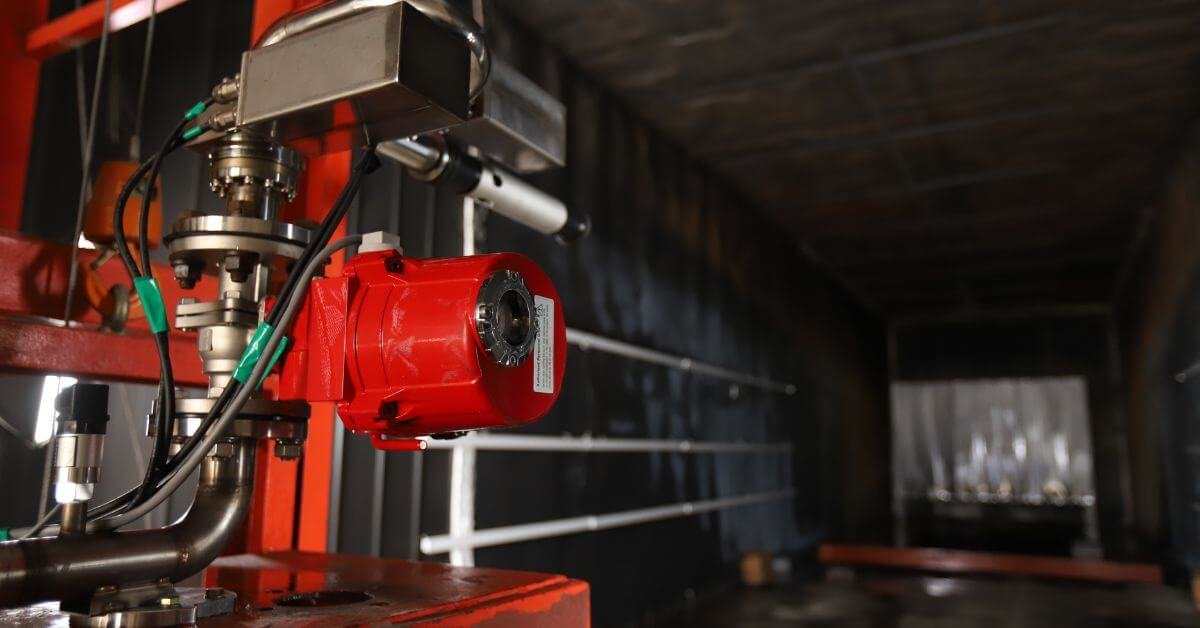
A next-generation fire suppression system capable of autonomously detecting oil fires aboard naval vessels and precisely targeting and extinguishing them even in maritime environments has been developed domestically for the first time.
The system uses AI to independently determine the authenticity of a fire, activating only when an actual fire occurs. It concentrates its discharge solely on the fire source, much like a firefighter extinguishing flames.
A research team led by Senior Researcher Hyuk Lee at the AX Convergence Research Center, Virtual Engineering Platform Research Division, Korea Institute of Machinery and Materials (KIMM, President Seog-Hyeon Ryu), has developed an autonomous initial suppression firefighting system specialized for shipboard oil fires and successfully completed real-ship trials on an actual vessel.
This newly developed initial suppression firefighting system for shipboard oil fires represents an advanced iteration of the research team’s autonomous firefighting technology, specifically engineered for the most common oil fires occurring on naval vessels. Its key feature is the ability to autonomously detect oil fires caused by equipment or aircraft leaks in engine rooms, hangars, decks, etc., and accurately target and extinguish the fire source even under complex environmental conditions such as sea waves and ship motion.
Existing shipboard firefighting systems release extinguishing agents throughout the entire affected area upon fire detection. This approach caused unnecessary damage during false alarms and made precise targeting difficult in maritime environments. In contrast, the technology developed by the KIMM research team combines AI-based precision fire detection with reinforcement learning algorithms for maritime condition adaptation, dramatically overcoming these limitations.
The developed fire suppression system consists of fire detection sensors, fire monitors, and an analysis and control unit equipped with AI-based fire authenticity determination and location estimation capabilities. The system maintains a fire detection accuracy of over 98%, with a foam discharge range reaching approximately 24 meters. It has also been verified to operate stably even in sea states of 3 or higher.
The research team conducted systematic performance verification using a large-scale land-based simulation facility (25m×5m×5m) that perfectly replicates the actual ship environment. Within the simulation facility, which replicated the color and illumination of actual ship compartments, various oil fire conditions and non-fire situations that could be mistaken for fires (lighters, welding, electric heaters, etc.) were reproduced to perform pre-training and accuracy testing of the AI system.
Notably, successful suppression tests were completed for open-area oil fires (maximum 4.5㎡ oil tray) and shielded fires (helicopter-sized shield installed 50cm above a 3.0㎡ oil tray) that could occur from leaks in aircraft carriers, proving the system’s capability to respond to all types of oil fires possible on actual vessels.
Subsequently, the research team conducted real-ship tests aboard the LST-II class amphibious assault ship (ROKS Ilchulbong) and successfully achieved precise targeting of extinguishing water onto a fire source 18m away in actual sea conditions with 1m waves. To accomplish this, they developed and pre-trained a reinforcement learning-based algorithm that recalculates the aiming angle in real-time by reflecting wave and hull motion using only 6-degree-of-freedom acceleration data.
Senior Researcher Hyuk Lee of KIMM stated, “This newly developed initial suppression firefighting system for shipboard oil fires is the world’s first technology to complete step-by-step verification from land-based simulation facilities to actual shipboard environments.” He added, “It can autonomously respond to the most dangerous oil fires on ships in both open and shielded conditions, marking a groundbreaking turning point for crew safety and preserving the ship’s combat effectiveness.” He further noted, “This technology is applicable not only to various naval vessels but also to ammunition depots, military supply warehouses, aircraft hangars, and offshore plants. Its future expansion to civilian ships and petrochemical facilities will significantly enhance fire safety at sea and in industrial settings.”
This research was conducted as part of the ‘Civilian-Military Practical Application Linkage Project’ implemented by the Institute of Civil Military Technology Cooperation. Participants included the Korea Institute of Civil Engineering and Building Technology, Chungnam National University, Super Century Co., Ltd., and the Korea Military Academy.
Press Release
1. eBooks for Engine Department
Master machinery operations, troubleshooting, and safety procedures with expertly written guides tailored for marine engineers. Prevent costly breakdowns and onboard accidents through practical knowledge.
👉 Explore Engine Department eBooks
2. eBooks for Deck Department
Sharpen your seamanship, navigation, and cargo-handling skills with real-world case studies and practical insights designed for deck officers and cadets.
👉Discover Deck Department eBooks
3. eBooks on Electrical Fundamentals & Issues
Understand marine electrical systems, identify potential faults, and prevent onboard electrical failures with step-by-step explanations from industry experts.
4. Pocket Guides for Quick Reference
Compact, handy, and loaded with essential checklists—perfect for on-the-go reference during operations and emergencies at sea.
5. Combo Packs to Save Big
Access multiple expert eBooks at discounted prices. Ideal for professionals seeking complete safety and operational knowledge across various ship departments.
6. Digital Maritime Courses – Learn at Your Own Pace
Upgrade your competence with Marine Insight Academy’s online courses. Learn from industry professionals anytime, anywhere, and become a safer, smarter seafarer.
Disclaimer :
The information on this website is for general purposes only. While efforts are made to ensure accuracy, we make no warranties of any kind regarding completeness, reliability, or suitability. Any reliance you place on such information is at your own risk. We are not liable for any loss or damage arising from the use of this website.
Disclaimer :
The information on this website is for general purposes only. While efforts are made to ensure accuracy, we make no warranties of any kind regarding completeness, reliability, or suitability. Any reliance you place on such information is at your own risk. We are not liable for any loss or damage arising from the use of this website.