U.S. District Court Dismisses Constitutional Case ...
54 minutes ago

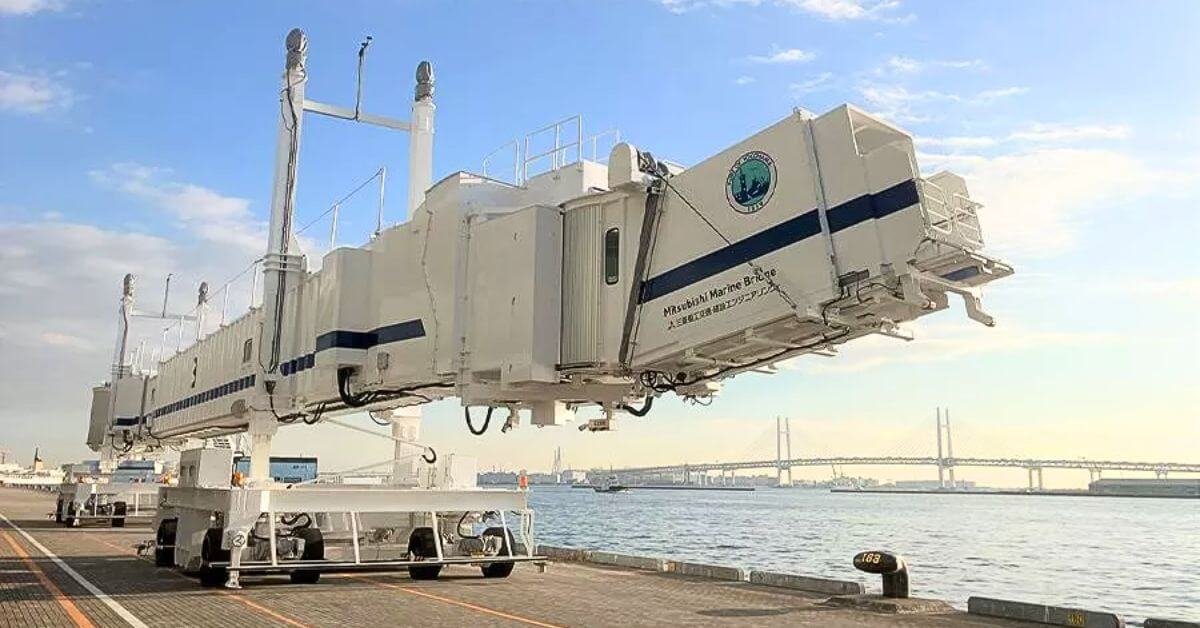
Mitsubishi Heavy Industries Transportation and Construction Engineering, Ltd. (MHI-TC), a part of Mitsubishi Heavy Industries (MHI) Group, has built and completed delivery to Yokohama City of the Mitsubishi Marine Bridge (MMB), a self-propelled mobile seaport passenger boarding bridge (SPBB).
Manufactured at MHI’s Mihara Machinery Works in Hiroshima Prefecture, the MMB was put into service at Osanbashi Yokohama International Passenger Terminal on January 13.
Capable of connecting to the large cruise ships that dock at Osanbashi, this is MHI-TC’s first delivery of a mobile MMB.
The MMB protects passengers from inclement weather and temperature, ensuring safe, secure, and comfortable passenger movement.
In addition, passengers do not need to descend to the wharf, enhancing security and making more effective use of wharf space.
The autonomous driving function of the mobile MMB was designed by MHI-TC by applying technology developed for the company’s fully automated docking system for airport passenger boarding bridges (PBBs).
The main characteristics are as follows.
Features of the Mobile MMB Developed by MHI-TC
The Port of Yokohama opened in 1859, and the current Osanbashi Yokohama International Passenger Terminal was completed in 2002.
It is the port of registry for the cruise ships ASUKAⅡand ASUKAⅢ, and one of the top ports in Japan for the number of cruise ship visits.
Osanbashi Yokohama International Passenger Terminal is also a tourist attraction, visited by more than three million people annually.
MHI-TC will continue to contribute to the safe and smooth operation of ships through the manufacture and delivery of mobile MMBs.
Press Release
Disclaimer :
The information on this website is for general purposes only. While efforts are made to ensure accuracy, we make no warranties of any kind regarding completeness, reliability, or suitability. Any reliance you place on such information is at your own risk. We are not liable for any loss or damage arising from the use of this website.
Disclaimer :
The information on this website is for general purposes only. While efforts are made to ensure accuracy, we make no warranties of any kind regarding completeness, reliability, or suitability. Any reliance you place on such information is at your own risk. We are not liable for any loss or damage arising from the use of this website.
1. eBooks for Engine Department
Master machinery operations, troubleshooting, and safety procedures with expertly written guides tailored for marine engineers. Prevent costly breakdowns and onboard accidents through practical knowledge.
👉 Explore Engine Department eBooks
2. eBooks for Deck Department
Sharpen your seamanship, navigation, and cargo-handling skills with real-world case studies and practical insights designed for deck officers and cadets.
👉Discover Deck Department eBooks
3. eBooks on Electrical Fundamentals & Issues
Understand marine electrical systems, identify potential faults, and prevent onboard electrical failures with step-by-step explanations from industry experts.
4. Pocket Guides for Quick Reference
Compact, handy, and loaded with essential checklists—perfect for on-the-go reference during operations and emergencies at sea.
5. Combo Packs to Save Big
Access multiple expert eBooks at discounted prices. Ideal for professionals seeking complete safety and operational knowledge across various ship departments.
6. Digital Maritime Courses – Learn at Your Own Pace
Upgrade your competence with Marine Insight Academy’s online courses. Learn from industry professionals anytime, anywhere, and become a safer, smarter seafarer.
By subscribing, you agree to our Privacy Policy and may receive occasional deal communications; you can unsubscribe anytime.