Wärtsilä: All-Time High Operating Result And Cash ...
1 month ago

As maritime shipping weighs a tentative return to the Suez Canal after two years of Red Sea diversions, a dangerous convergence of Houthi warnings and U.S. military escalation threatens to upend the industry’s fragile hopes for stability in one of the world’s most critical waterways.
Martin Kelly, Head of Advisory at EOS Risk Group, warned that Houthi forces have ramped up their propaganda operations and issued “chilling” new video footage showing attacks against shipping in the Red Sea and Gulf of Aden. The only caption: “soon.”
“Multiple pro-Houthi figures shared the video claiming they would stand alongside Iran in the face of a US and/or Israeli attack,” Kelly noted, highlighting the group’s explicit solidarity with Tehran at a moment of heightened regional tensions.
In a separate video statement, Houthi spokesman Brigadier Yahya Saree reinforced the group’s position amid escalating possibilities of military strikes against Iran. “We affirm our position: our dear Yemeni people, with its great people and its faithful leadership, its mujahideen army, and its stand alongside any Arab or Islamic country exposed to Zionist aggression,” Saree declared.
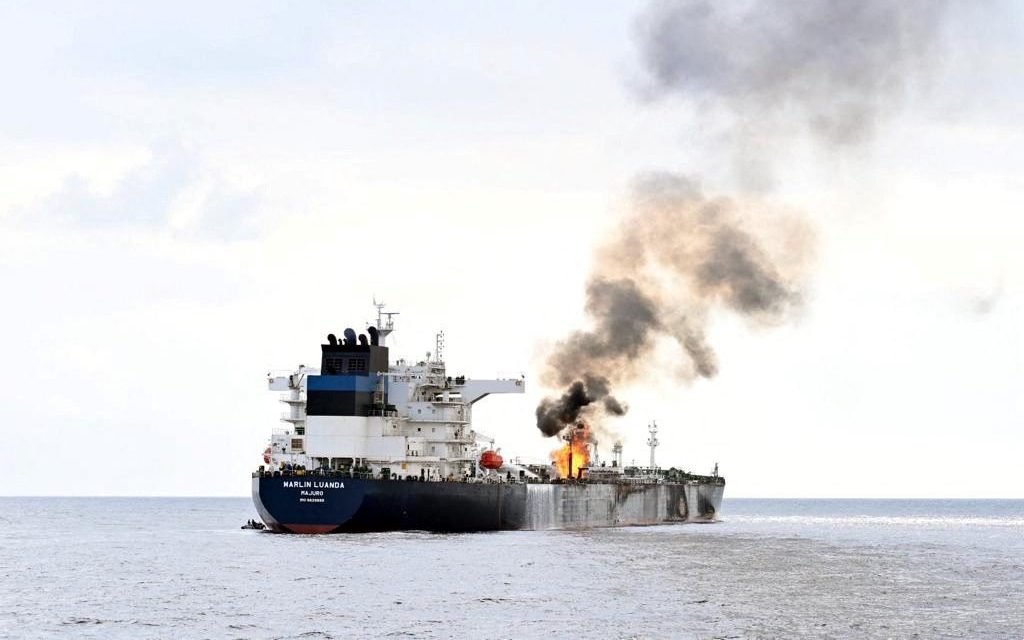
The timing could hardly be worse for an industry already struggling with unpredictability. Kelly observed that Houthi media personnel “have seemingly been recalled from leave as their propaganda machine has been restarted,” warning they plan to release footage of the attack against MARLIN LUANDA “intended to be a stark reminder of Houthi capabilities and a deterrent to the US and its allies against military activity against Iran.”
The tanker Marlin Luanda was struck by a Houthi missile in the Gulf of Aden, 60 nautical miles southeast of Yemen, on January 26, 2024. The missile ignited a fire in a cargo tank carrying naphtha. The crew, with help from U.S., French, and Indian naval forces, extinguished the fire with no injuries. The Houthis claimed responsibility, calling it retaliation for U.S.-UK strikes in Yemen. The incident marked a serious escalation of the Red Sea shipping crisis.
The latest warnings now carry added weight as U.S. military assets flood into the region. According to reports, the aircraft carrier USS Abraham Lincoln and several guided-missile destroyers have crossed into the Middle East region under U.S. Central Command.
President Donald Trump confirmed Thursday that the United States had an “armada” heading toward Iran, though he expressed hope he would not have to use it.
The military buildup follows escalating tensions after a crackdown on protests across Iran, with Trump having repeatedly threatened intervention if Iran continued to kill protesters. The warships began deploying from the Asia-Pacific region earlier this month.
In addition to the carrier group, the Pentagon is moving fighter jets and air-defense systems to the Middle East. Over the weekend, the U.S. military announced it would carry out an exercise in the region “to demonstrate the ability to deploy, disperse, and sustain combat airpower.”
A senior Iranian official warned last week that Tehran would “consider any attack” as an “all-out-war against us,” underscoring the potential for rapid escalation.
The United Arab Emirates moved quickly to distance itself from potential conflict, stating Monday that “it will not let” its airspace, territory or territorial waters be used for any hostile military actions against Iran—a significant declaration given that the U.S. military’s Al Dhafra Air Base is located south of Abu Dhabi and serves as a critical Air Force hub for regional operations.
The escalating security crisis comes just as major carriers were attempting their first sustained return to Red Sea transits. Earlier this month, shipping giant Maersk announced its first structural return to the Suez Canal in over two years. But competitor CMA CGM abruptly reversed its own Red Sea plans, rerouting three major services back around the Cape of Good Hope.
“Shippers crave predictability in supply chains,” Xeneta Senior Market Analyst Destine Ozuygur said in analyzing CMA CGM’s reversal. “Carriers taking the decision to return to the Red Sea then reversing that decision—even if it is done for important safety reasons—still risks undermining confidence in schedule reliability and eroding trust in partnerships.”
The Red Sea crisis began on November 19, 2023, when Iranian-backed Houthi forces seized the Galaxy Leader following the breakout of the Gaza War. More than 100 merchant vessels were subsequently targeted, with four ships sunk, one seized, and at least eight seafarers killed.
While a Gaza ceasefire in October 2025 had raised hopes for normalized traffic, the convergence of renewed Houthi threats and U.S. military buildup now casts doubt on whether any genuine stability can take hold. With Houthi forces explicitly declaring solidarity with Iran and the U.S. positioning what Trump calls an “armada” in the region, the shipping industry’s brief window of optimism may be closing as quickly as it opened.
Sign up for gCaptain’s newsletter and never miss an update