Wärtsilä: All-Time High Operating Result And Cash ...
1 month ago


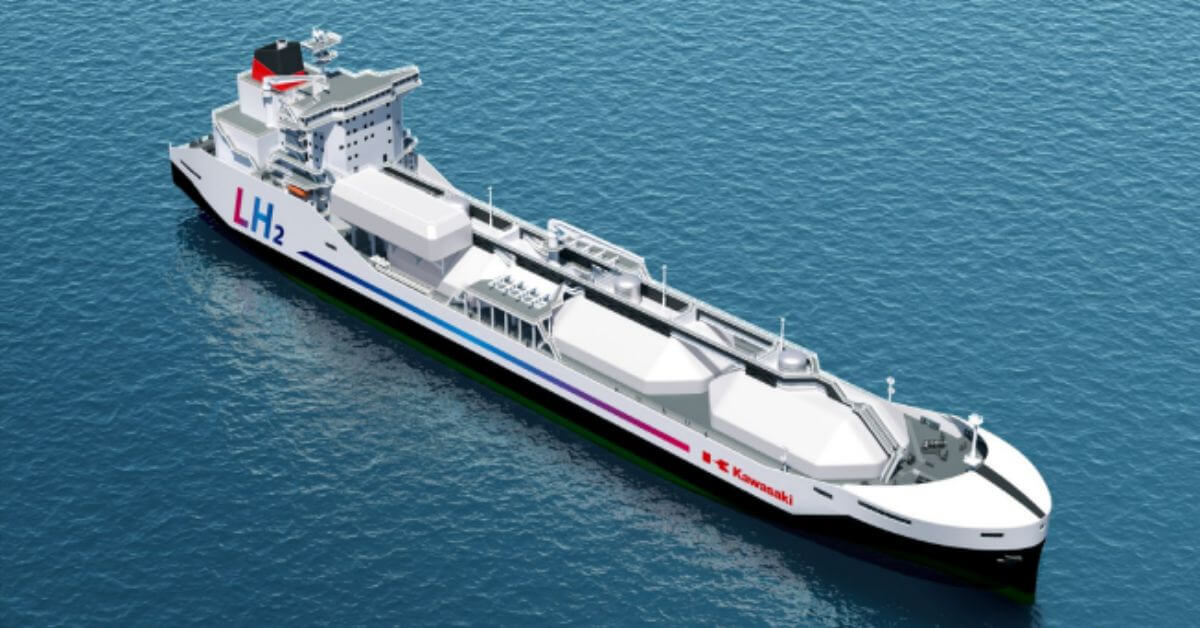
Kawasaki Heavy Industries has signed a contract with Japan Suiso Energy (JSE) to build the world’s largest liquefied hydrogen carrier, a vessel intended to support the future commercial transport of hydrogen.
The ship will have a cargo capacity of about 40,000 cubic metres and will be built at Kawasaki’s Sakaide Works in Kagawa Prefecture, western Japan.
JSE is acting as the operator for the New Energy and Industrial Technology Development Organization’s (NEDO) Green Innovation Fund project.
The project aims to demonstrate ship-to-base loading and unloading of liquefied hydrogen and to carry out ocean-going trials by the fiscal year ending March 2031.
These trials are planned to confirm performance, safety, durability, reliability and economic feasibility.
Kawasaki Heavy Industries has previous experience in liquefied hydrogen transport. In 2021, the company built the world’s first liquefied hydrogen carrier, the 1,250-cubic-metre Suiso Frontier.
In 2022, the vessel took part in a pilot demonstration between Japan and Australia, which successfully showed that liquefied hydrogen could be safely loaded, transported and unloaded.
The company has indicated that the new vessel has been designed to meet the expected increase in global hydrogen demand in the 2030s. It is intended to play a key role in forming a commercial-scale liquefied hydrogen supply chain.
The carrier will be equipped with cargo tanks capable of storing around 40,000 cubic metres of liquefied hydrogen.
A high-performance insulation system will be used to reduce boil-off gas caused by heat entering from outside, allowing efficient transport of cryogenic hydrogen.
The vessel will feature an electric propulsion system that includes a hydrogen and oil dual-fuel generator engine as well as a conventional oil-fired generator engine.
It will also be fitted with a hydrogen gas supply system, including a compressor and heat exchanger, enabling boil-off gas from the cargo tanks to be reused as fuel and reducing carbon dioxide emissions during transport.
A cargo handling system designed for large-volume liquefied hydrogen transfer will be installed. Double-wall, vacuum-jacketed piping will maintain extremely low temperatures during loading and unloading operations between the vessel and onshore facilities.
The ship’s hull shape and draft have been designed to account for the low density of liquefied hydrogen, reducing power requirements and improving propulsion efficiency.
Risk assessments have been carried out on the hydrogen fuel system, fuel supply system and cargo handling systems, with safety measures included to protect the crew, the environment and the vessel’s structural integrity.
The vessel is expected to operate alongside onshore infrastructure, including a liquefied hydrogen receiving terminal currently under construction at Ogishima in Kawasaki City.
Reference: Kawasaki
Disclaimer :
The information on this website is for general purposes only. While efforts are made to ensure accuracy, we make no warranties of any kind regarding completeness, reliability, or suitability. Any reliance you place on such information is at your own risk. We are not liable for any loss or damage arising from the use of this website.
Disclaimer :
The information on this website is for general purposes only. While efforts are made to ensure accuracy, we make no warranties of any kind regarding completeness, reliability, or suitability. Any reliance you place on such information is at your own risk. We are not liable for any loss or damage arising from the use of this website.
1. eBooks for Engine Department
Master machinery operations, troubleshooting, and safety procedures with expertly written guides tailored for marine engineers. Prevent costly breakdowns and onboard accidents through practical knowledge.
👉 Explore Engine Department eBooks
2. eBooks for Deck Department
Sharpen your seamanship, navigation, and cargo-handling skills with real-world case studies and practical insights designed for deck officers and cadets.
👉Discover Deck Department eBooks
3. eBooks on Electrical Fundamentals & Issues
Understand marine electrical systems, identify potential faults, and prevent onboard electrical failures with step-by-step explanations from industry experts.
4. Pocket Guides for Quick Reference
Compact, handy, and loaded with essential checklists—perfect for on-the-go reference during operations and emergencies at sea.
5. Combo Packs to Save Big
Access multiple expert eBooks at discounted prices. Ideal for professionals seeking complete safety and operational knowledge across various ship departments.
6. Digital Maritime Courses – Learn at Your Own Pace
Upgrade your competence with Marine Insight Academy’s online courses. Learn from industry professionals anytime, anywhere, and become a safer, smarter seafarer.
By subscribing, you agree to our Privacy Policy and may receive occasional deal communications; you can unsubscribe anytime.