Nikos Kakalis appointed Managing Director of the M...
1 hour ago


U.S. enforcement and intelligence agencies confront a maritime threat environment characterized by systematic deception and accelerating evasion tactics. Adversarial actors employ coordinated Automatic Identification System (AIS) manipulation campaigns. GPS interference has degraded navigational integrity for over 11,000 vessels in a single quarter. Fraudulent flag-of-convenience registries proliferate at rates that exceed regulatory response capacity. Identity laundering schemes obscure beneficial ownership across multiple jurisdictions, degrading attribution and accountability.
The cumulative effect is a critical intelligence gap that undermines mission assurance. Legacy AIS-dependent monitoring and reactive imagery collection prove insufficient against adversaries who exploit known system vulnerabilities and operate within regulatory seams.
Federal agencies face a mission-critical operational imperative: establishing verifiable ground truth in contested maritime domains.
A Mission-Integrated Platform Linking Detection to Decisive Action
Windward’s Remote Sensing Intelligence (RSI) solution was purpose-built to address this capability deficit. RSI integrates multi-sensor satellite collection — electro-optical (EO), synthetic aperture radar (SAR), and radio frequency (RF) — with advanced behavioral analytics, ownership network mapping, cargo provenance tracking, and sanctions exposure modeling. Rather than delivering unprocessed imagery, RSI generates contextualized intelligence assets optimized for operational tempo and warfighting decision cycles.
Analysts receive comprehensive vessel assessments providing a complete operational picture into vessel identity, behavioral history, pattern-of-life analysis, and prioritized risk indicators, fused directly to specific detections, enabling rapid decision superiority.
Mission-Critical Capabilities RSI Delivers to Federal Stakeholders
1. Assured Surveillance of Non-Cooperative Vessels
RSI fuses EO, SAR, and RF data streams with predictive behavioral models to expose AIS spoofing, vessel identity switching, deceptive routing patterns, course deviations, and cargo origin masking operations. This generates an evidence-based operational picture independent of adversary-controlled broadcast signals, ensuring continuous domain awareness across peacetime enforcement and warfighting contingencies.
2. Decision-Quality Intelligence at Operational Speed
Automated correlation engines match imagery with vessel databases, beneficial ownership records, and Treasury Department sanctions lists. This compression of analysis timelines (from days to hours) delivers decision-quality intelligence at operational speed, essential for time-sensitive interdiction operations, tactical boarding decisions, and real-time threat assessment in contested environments. Every collection is targeted, timely, and mission-ready, ensuring operational resources are applied with tactical precision.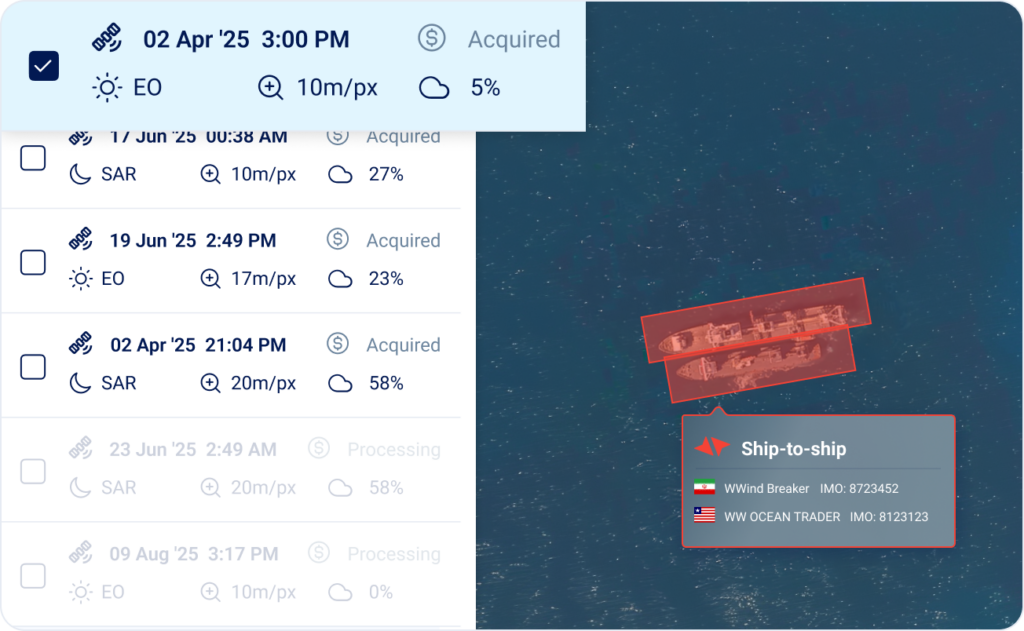
3. Effects-Based Collection Management
RSI employs algorithmic sensor selection, weather constraint optimization, and risk-driven tasking protocols. Windward’s Gen AI maritime agent MAI Expert™ conducts automated feasibility assessments, analyzes satellite availability and weather conditions, and recommends optimal sensors and providers for each operation. This collection architecture maximizes intelligence value per asset, reduces wasteful tasking expenditures, and ensures optimal resource allocation across competing operational requirements.
4. Unified Intelligence Architecture
Traditional maritime intelligence operations have required analysts to work across separate platforms — one for operational tasks such as lead generation and imagery tasking, another for analytical assessment and investigation. This fragmentation introduces delays, increases the risk of analytical gaps, and forces teams to manually bridge disconnected workflows.
The integrated Imagery & RF Hub consolidates all detection events and collection products within a single analytical environment. Users can procure archived imagery, task new collections, upload proprietary imagery through Bring Your Own Imagery (BYOI) capabilities, and conduct collaborative analysis with real-time annotation and commentary.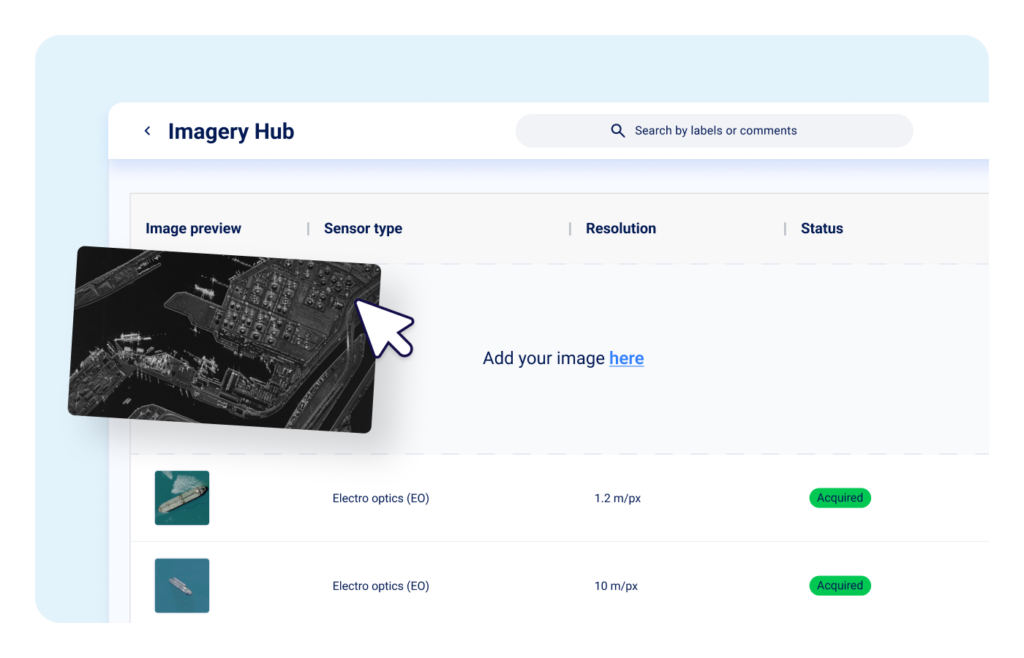
By unifying operational execution with deep analytical capability, Windward eliminates the need to toggle between systems, enabling seamless workflows from initial detection through final intelligence assessment. MAI Expert™ provides mission planning support, feasibility analysis, and automated investigation summaries, eliminating intelligence stovepipes and ensuring unified situational awareness across federal stakeholders. Processes that once required coordination across four to six separate systems now execute seamlessly within one platform.
Operational Effects Across Federal Mission Sets
Detect and interdict illicit ship-to-ship (STS) transfers and sanctions regime violations.
Conduct persistent monitoring of uncooperative vessels within Exclusive Economic Zones (EEZs) and strategic maritime chokepoints.
Identify and disrupt transnational smuggling networks, weapons proliferation channels, espionage operations, and organized maritime crime.
Validate cargo provenance in high-risk commodity flows supporting sanctions enforcement.
Investigate fraudulent vessel registries and beneficial ownership obfuscation schemes.
Protect critical maritime infrastructure and maintain freedom of navigation in contested waters.
Monitor unauthorized construction or accumulation near offshore facilities, restricted waters, and critical infrastructure including pipelines and subsea cables.
Why RSI Represents a Mission-Essential Capability
Three converging threat dynamics define the current maritime operating environment:
Accelerating adversary gray zone tactics in deception and evasion.
Increasing data fragmentation across collection platforms and intelligence systems.
Elevated standards for actionable intelligence supporting legal authorities and warfighting operations.
RSI integrates these disparate elements into a coherent intelligence product, transforming raw detections into legally defensible, operationally actionable intelligence. For federal agencies requiring speed, precision, and verified intelligence to support enforcement actions and warfighting mission sets, RSI addresses critical capability gaps that legacy systems cannot close.
Assess Platform Capabilities Through Operational Demonstration
RSI currently supports federal government missions requiring threat validation, activity confirmation, and decision support across multiple operational theaters. A classified or unclassified demonstration enables mission stakeholders to evaluate how integrated detection, imagery intelligence, and contextual analysis combine to deliver a single, authoritative common operational picture.
Source: Windward